A NEW KIND OF HEEL FOR THE CONCRETE JUNGLE
Footwear has long asked the wearer to make a choice: the disciplined silhouette of a dress shoe, the secure footing of a walking shoe, or the technological complexity of specialty equipment. The Electrolips footwear series proposes a different arrangement. The external fashion remains unmistakably dress footwear; the structure beneath it becomes a family of mechanical systems with replaceable wear surfaces, serviceable components, and carefully managed motion. A stiletto, a low sport heel and a high urban boot no longer need to share identical geometry to share the same engineering principles.
Across the illustrated collection, the recurring signature is the recognition that a heel is not merely a decorative column. It is a load-bearing component responsible for transmitting a changing combination of downward force, sideways force, bending and twisting into the floor. A slender heel is especially exposed to those demands. Instead of disguising the joint as a continuous ornamental surface, Electrolips makes the interface visible and gives it a defined sequence of motion, compliance and limiting contact.
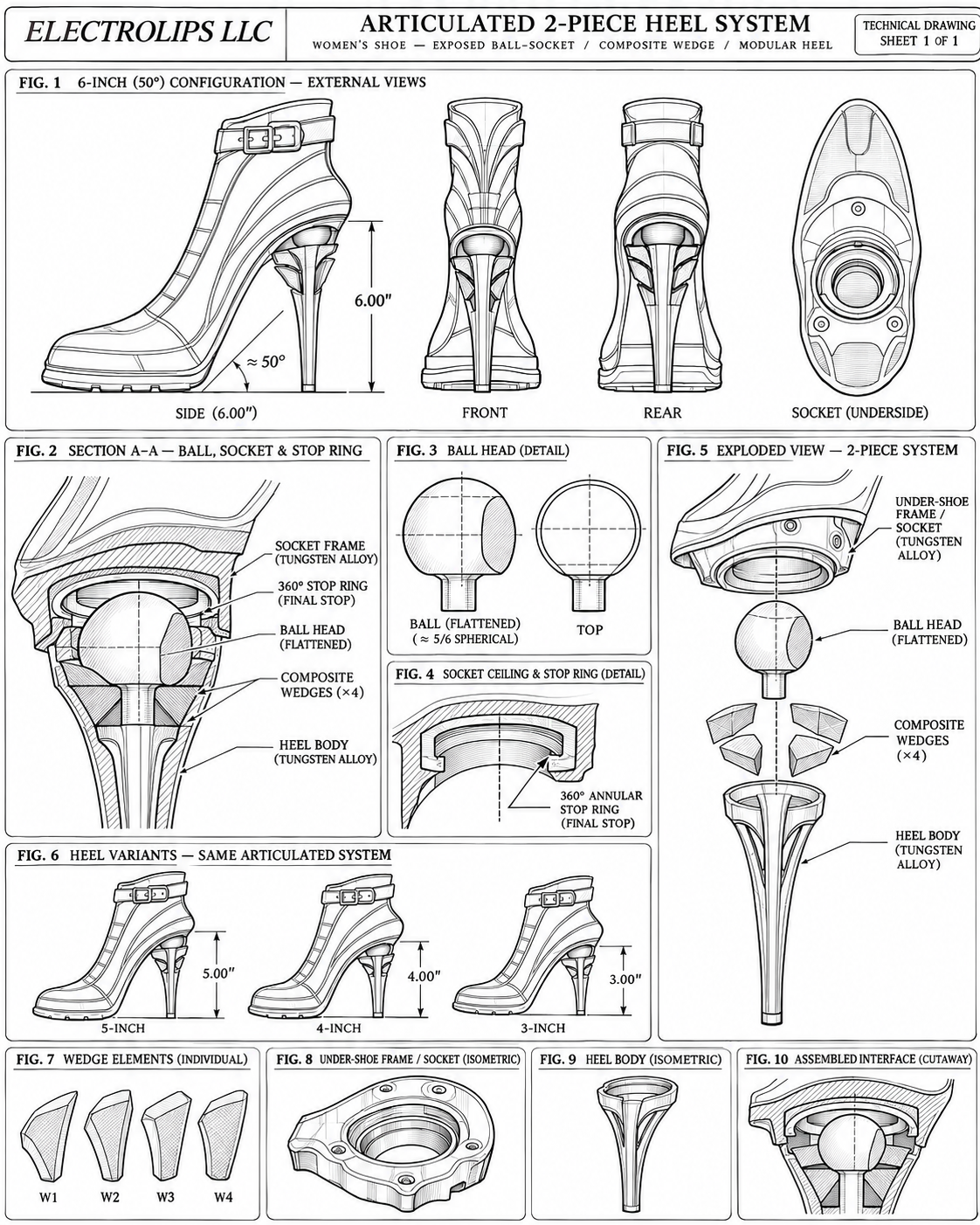
The most original design direction in these boards is the exposed articulated heel: a separate shoe-side metal socket; a separate heel shaft carrying a spherical top key; and independently positioned composite flexor elements. The flexors are proposed to cushion small movements and recover after loading. If the design reaches its intended angular travel limit, a geometric contact surface takes over from the cushioning elements. This is a compelling mechanical architecture because it separates the tasks of movement accommodation and movement limitation, allowing each to be investigated and tuned independently.
That distinction is the basis of a favorable design review, not a claim of proven safety. The drawings show credible directions for prototyping, but they do not prove that a finished shoe reduces falls or heel fractures. Those outcomes depend on complete-footwear stability, traction, center of pressure, ankle behavior, wear and manufacturing tolerances. Electrolips has, nevertheless, assembled a coherent portfolio around questions that conventional fashion marketing often leaves unanswered: what wears out first, what can be replaced, and how can the shoe respond when the wearer changes direction?
The styling remains ambitious. Polished metallic finishes, architectural shafts and illuminated outsole edges appear in collection boards alongside technical cutaways. The visual language is purposely urban: luminous seam accents, formal coats, armored-looking boots and heels that combine slender lines with a sense of exposed machinery. This is fashion design organized around maintainable mechanical systems rather than technology appended after the silhouette has already been fixed.
THE TWO-PIECE ARTICULATED HEEL
The revised Electrolips joint should be understood as two exposed major structural components, plus separate replaceable or tunable flexors. The first major component is the underside shoe frame carrying a concave spherical socket. The second is the heel body, whose upper end terminates in a ball or specially shaped spherical key. The shaft grows from the side of the ball opposite the flattened upper crown. The flat is not the heel’s attachment face. Its perimeter, or a revised keyed geometry, is a potential hard-stop contact feature.
In the flat-crown concept, a smaller-diameter raised annular ridge is situated nearer the middle of the socket’s ceiling. The perimeter of the ball’s flattened crown is intended to reach that ridge when the joint has tilted far enough. Because the ridge encircles the socket, the concept provides a 360-degree travel-limiting principle. Ball-crown diameter, ridge diameter and spacing influence the available travel, subject to the rest of the socket geometry. The goal is to avoid asking the soft flexors to be the ultimate load-bearing stop.
Compression of the independent flexor wedges comes first. Final metal-to-metal stop contact comes second. Return motion follows when the external load is removed, provided the flexors stay within an elastically recoverable range. The imagery envisages high-grade structural alloys and optional tungsten-alloy wear members. The desire to withstand a roughly 1,000-pound peak is a proposed target; no drawing alone establishes that capacity, and actual human-wear safety would require a full structural and biomechanical test program.
Several figure sheets then explore a deliberately different final-stop method: instead of a flat ring contacting a raised ridge, a spherical key incorporates negative-space reliefs that meet protrusions inside the socket. The four-lug variant has broad relief pockets, creating a simple geometry with comparatively few contact features. The sixfold version uses trapezoidal radial channels and matching protrusions. The three-lobed version introduces stronger visual geometry with large curving stop faces and sculptural load paths. These are alternatives to evaluate, not interchangeable finished parts: each would need its own contact-stress, tilt-range and wear analysis.
For a short and wide sport heel, the same idea may offer different priorities. A larger support footprint can leave more room for the socket, more substantial flexor elements and a broad floor-contact tread. The intention is not to make walking rigid. It is to permit limited movement, provide a restoring response and prevent uncontrolled travel beyond a designed threshold. That resembles the design logic of a stabilizer paired with a mechanical travel stop; the actual gait benefit remains to be measured on test users and varied surfaces.
REPLACEABLE TREADS: KEEP THE SHOE, CHANGE THE WEAR PART
The most immediately manufacturable element of the collection may be its replaceable ground-contact system. Six individually located outsole insert zones appear in the boot schematics, while the separate heel-tip study explores a compact serviceable tread cap. The design philosophy is consistent: a structural frame and a wear surface need not be discarded together. This promises a useful maintenance proposition for premium footwear, in which the outer appearance and principal architecture are intended to outlast the small surfaces that contact pavement.
For the stiletto, Electrolips illustrates a hollow heel shell that accepts an upward-projecting plug integrated with a replaceable tread tip. The plug establishes axial alignment and may help spread localized forces, provided the design includes an adequate retention shoulder and a positive mechanical lock. Suggested fastening families include threaded or bayonet-style interfaces, with a separate locking method needed to resist vibration and cyclic loosening. A taller plug is not automatically stronger: wall thickness, bending response, fit, fatigue and withdrawal resistance determine the actual result.
For medium and broad block heels, a larger replaceable contact cap offers more area for tread pattern experiments. The boards show herringbone, dotted, gridded and wave-like ground surfaces. A product line could offer city walking, event formalwear and wetter-weather inserts, but each combination must be evaluated on real surfaces before any slip-resistance claim is used. The interchangeable tip also suggests an attractive retail aftercare service: the customer returns for an inexpensive replacement part rather than needing to replace the entire shoe.
The coordinated boot platform extends this service concept to a six-region outsole: big-toe or thumb-toe, four-toe, outer arch, inner arch, ball and heel sections. Recessed insert pockets, visible fastening elements and replaceable wear layers are drawn in several technical boards. Depending on actual test results, those zones could support localized changes in traction, cushioning, abrasion resistance or color. The powerful product idea is not that every wearer needs six adjustments; it is that a manufacturer could use one modular platform to offer purposeful variations without reinventing every structural part.
SCREW-ADJUSTABLE AND PNEUMATIC HEELS
Two newer Electrolips concept sheets move beyond replaceable wear parts into adjustable height. In the screw-extension concept, a threaded member advances from within a heel housing. A guided outer tube resists unwanted rotation, a lock holds the chosen setting and a small forefoot pivot accommodates a change in overall shoe pitch. The technical attraction is adjustability: an evening shoe might move between configurations without replacing the entire heel assembly. Mechanically, however, the required geometry is substantial. The hinge must avoid pinching, the wearer’s foot must remain supported and both heel attachment and forefoot contact must be secure at every allowed height.
The pneumatic concept explores a straight-line heel extension with a miniature compressor and sealed chamber. The drawing is imaginative: a stiletto descends from a protected body in a linear deployment action, and a wider heel uses the same general package. For a realistic production design, air pressure should actuate or assist deployment, not serve as the sole structural support when the person stands. A mechanically positive lock must carry walking loads even if a seal leaks, the battery depletes or the compressor stops. A controlled, stationary-only adjustment interface would be preferable to any accidental deployment during a step.
Both systems open a promising style platform because the raised shoe can be visually distinct in each state. Yet this is the most development-intensive portion of the portfolio. Every height setting changes walking geometry, forefoot pressure, moments at the heel seat and the likelihood of snagging. Unlike the modular tread cap, the extension system is a complete safety-critical mechanism. Electrolips would best develop these as demonstrator prototypes and validate their loads, locks and user controls before presenting them as daily-wear features.
WHERE THIS COLLECTION FITS IN THE FOOTWEAR MARKET
The business opportunity is the combination of a distinctive visual identity and a serviceable product architecture. A runway presentation can introduce the illuminated stiletto and striking sculptural heel. A more conservative city line can then adopt the straightforward upgrades: replaceable heel tips, modular outsole grips, improved fastening and adjustable cushioning. A premium technical boot follows naturally as the next product family because it offers more internal volume for wiring, heating layers, environmental shielding and service modules.
The strongest position for an initial collection may be premium urban footwear with clear repairability. Consumers can immediately understand a shoe designed to keep its finish while its tread is renewed. They can also see the appeal of a visible engineered heel when it is treated as jewelry for the machine age. Separately, the future sporting and walking designs can emphasize a broad contact base and service-adjustable flexor packs. The audience for each line differs, but the language of interchangeable components ties them together.
The glowing sole rails, titanium-like finishes, high-polish metal bodies and mechanical details would give the runway collection an unmistakable signature. A city-fashion advertising campaign could display a model in a coordinated Electrolips outfit, followed by a second full-page advertisement showing the same shoe in a simple line-art cutaway. The first sells aspiration; the second explains why the product is different. The manufacturing story becomes part of the luxury story, rather than a technical footnote.
There is also a compelling after-sales model: replacement tread packs, authorized servicing, adjustable wedge kits, and seasonal outsole options. Those ideas could support a repeat relationship with the purchaser and preserve the original garment or shoe longer, subject to real durability and repair testing. No retail prices or mass-market sales projections are established by these boards; those require prototype bills of materials, factory quotations and demand research.
FROM LINE DRAWING TO PRODUCIBLE FOOTWEAR
The drawings already provide a useful manufacturing taxonomy: shoe-side frame; spherical or keyed joint; separate heel body; flexor wedges; positive stops; ground-contact inserts; and, in optional configurations, lighting and power modules. The first engineering task would be to convert each stylized arrangement into dimensioned CAD solids and physically separated assemblies. Movement envelopes, fastener access, allowable tolerances, service clearances and load paths must be stated before a supplier can judge production feasibility.
A high-grade structural metal is appropriate for the heel interface, but using tungsten alloy everywhere may create unnecessary weight, expense and manufacturing difficulty. Tungsten-heavy alloys are dense and can be challenging to machine; they may be justified as localized wear or contact inserts rather than the default material for an entire shoe frame. Corrosion-resistant stainless, appropriate titanium alloy, and other qualified engineering metals deserve comparative testing for strength, stiffness, fatigue, finish and cost. The particular selection must come from physical load cases, not appearance alone.
The independent flexors are central to user comfort and joint control. Their first prototypes should employ replaceable, individually characterized elastomeric or spring/composite modules. A manufacturer could then measure their force-versus-deflection curves, return behavior, changes with temperature, and fatigue after repeated load cycles. User customization becomes a calibrated component selection rather than merely trial and error without reference data. The rigid hard-stop interfaces should be engineered for acceptable contact stresses and non-jamming recovery after an overload.
For the structural heel and socket, the production path could begin with CNC-machined prototype units to establish contact geometry. Once testing stabilizes, suitable parts might transition to forging, investment casting, powder metallurgy or other processes after material qualification and cost analysis. The visible housing can be distinguished from the true load-bearing member, permitting diverse cosmetic finishes without altering the joint’s primary mechanics. Polymer sole frames could be molded with designed-in cavities for wear inserts, while service fasteners remain reachable from below.
The replaceable tread program is a practical early release candidate. Separate tooling for the base frame, a small family of tread compounds, a controlled plug geometry, and a positive retention test would give Electrolips a genuine physical system to demonstrate. The assembly should tolerate contamination from rain, grit and street dust. Sharp edges, trapped dirt, loose hardware and a tread tip that can rotate out of place are failure modes to eliminate during engineering review. The user-facing service procedure should remain simple enough for reliable replacement without special guesswork.
The screw and pneumatic models demand additional safeguards. Height adjustment should occur only when the shoe is not carrying body weight. The screw must have mechanical resistance to back-driving and an independent positional lock. Pneumatic action must use a physical load-bearing latch, a defined venting path and protection against accidental activation. A change in heel height cannot be treated as an isolated mechanical adjustment; it changes the pressure distribution at the forefoot. Both mechanisms need wear testing, gait observation and failure-mode analysis before any consumer trial.
An ambitious longevity objective appears in the design discussion: roughly 80,000 hours of cumulative service with tread replacement and proper maintenance. That is a proposed engineering ambition, not a supported warranty. A legitimate warranty must be derived from cycle, fatigue, impact, environmental and field-life evidence, with separate limits for structural members and replaceable components. The original boards therefore establish a development roadmap rather than a tested service-life specification.
DESIGNED TO ADDRESS THE WEARER’S REAL CONCERNS
A slender heel raises understandable concerns about sideways movement, ground traction and failure of the heel-to-shoe attachment. Electrolips addresses those concerns at the architecture level. The controlled joint is intended to provide some compliant response to load; the hard stop is intended to prevent indefinite articulation; and the replaceable tread lets the wearer restore a worn contact surface. Those are concrete engineering directions worth pursuing. They are not yet evidence that falls, ankle injuries or heel breakages will be eliminated or reduced.
In the broad sport-heel interpretation, the system could combine a more substantial base with tuned flexors and a robust travel limit. This may prove more practical as an initial walking demonstrator than a tall stiletto, because the wider package gives the engineers room for larger components and a more forgiving tread footprint. In the dress-stiletto interpretation, precision and compactness will be more demanding. Both models should be evaluated on level dry floors, wet floors, stairs, varied pavements and unexpected directional steps under controlled conditions.
Comfort is personal and cannot be specified entirely by the shoe’s appearance. Electrolips’s proposal for different flexor thresholds allows the engineering team to explore individualized motion resistance. The responsible retail model would use validated settings with defined safe ranges, rather than suggest that a customer can freely change structural capacity without test data. Proper fit, ankle support, traction, training and maintenance remain as important as the internal joint.
THE ELECTROLIPS FOOTWEAR CAMPAIGN
COMPLETE FOOTWEAR IMAGE INDEX
This catalog contains every distinct footwear-bearing board selected from the images available in this conversation. Repeated copies are omitted, with their alternate filenames recorded in the included README. Select a category or type a filename to find a drawing. Select an image to enlarge it.
30 drawings shown
articulated_two_piece_heel_patent_drawing.pngOpen full-size drawing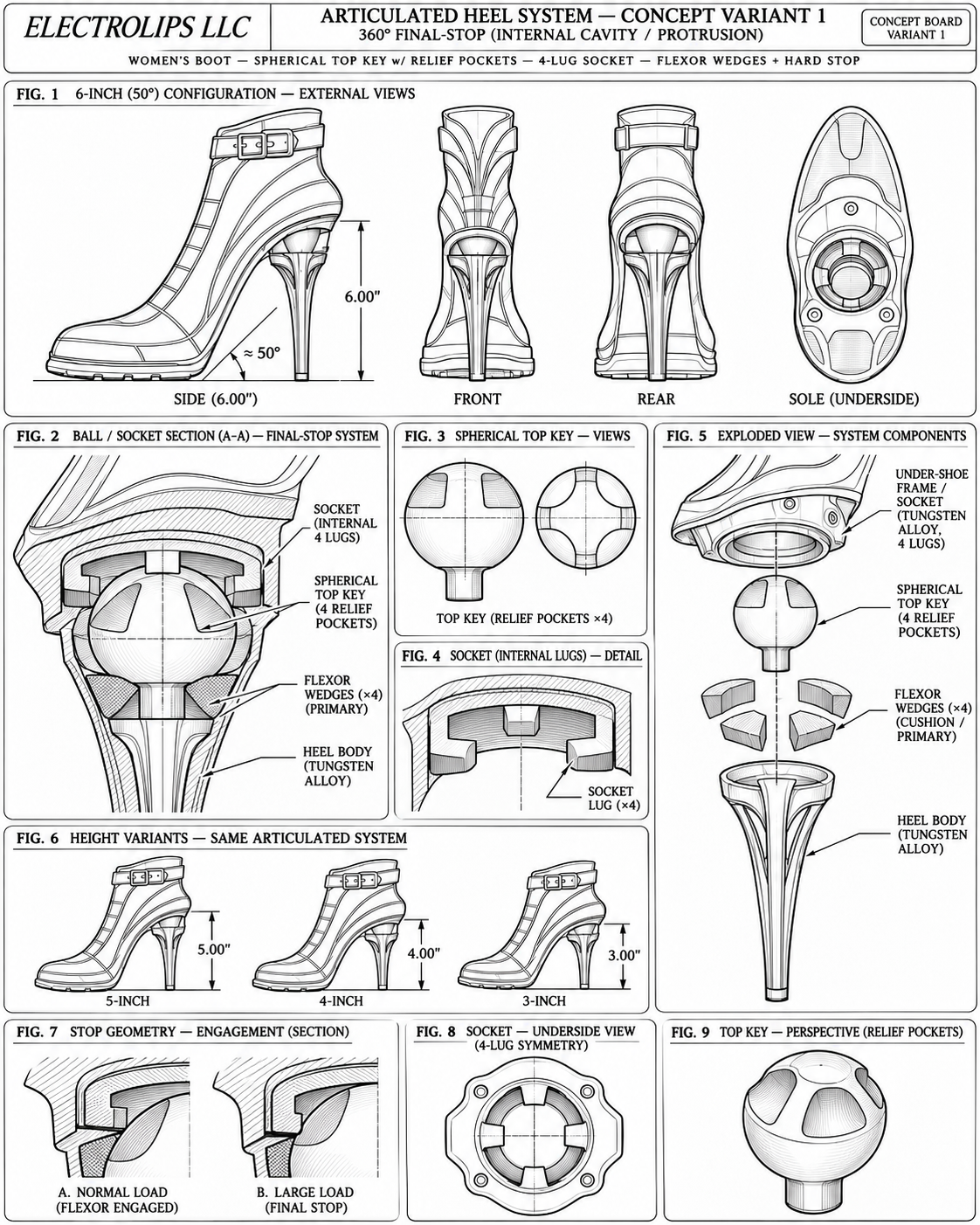
articulated_heel_system_concept_board.pngOpen full-size drawing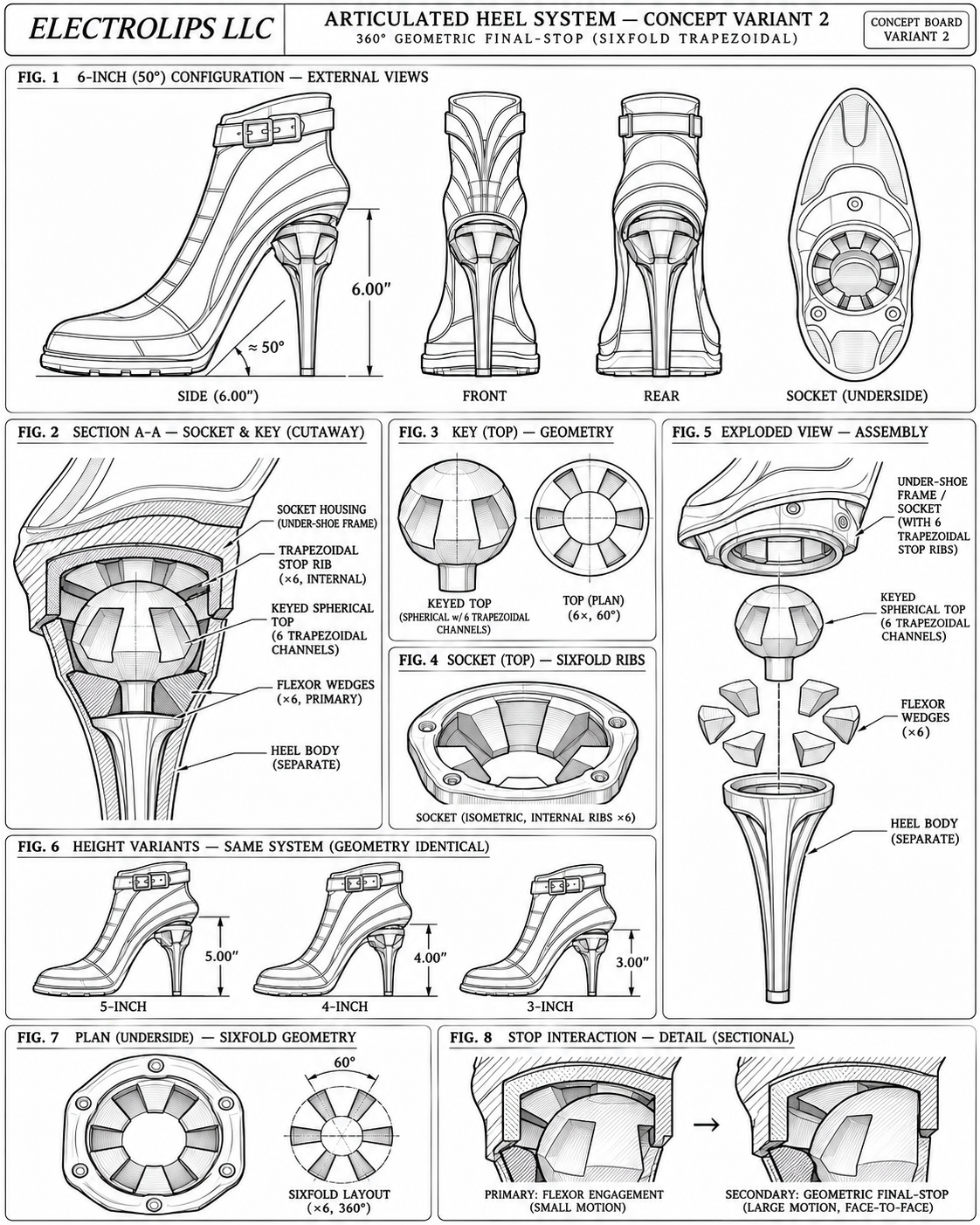
electrolips_articulated_heel_blueprint.pngOpen full-size drawing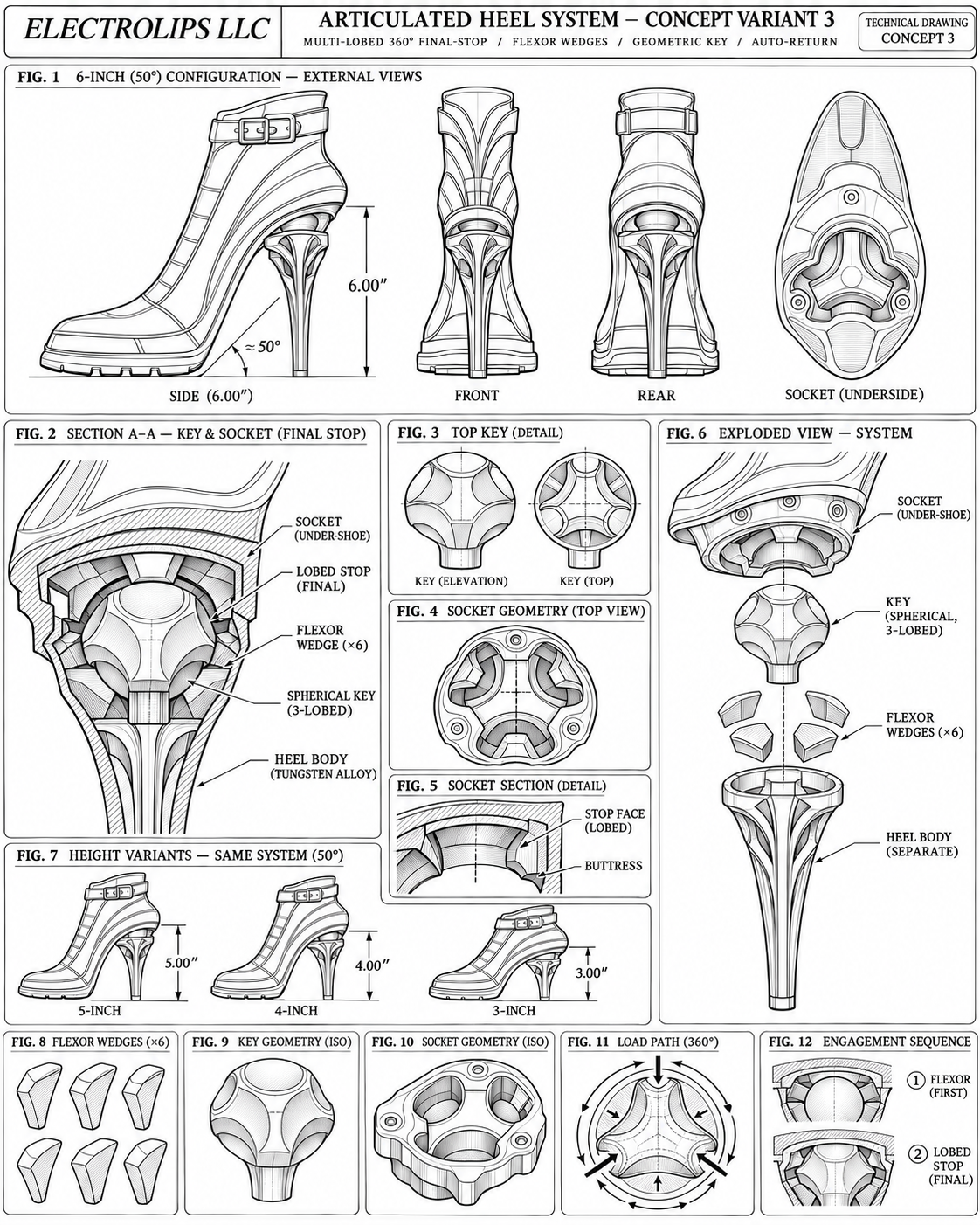
articulated_heel_system_technical_plate.pngOpen full-size drawing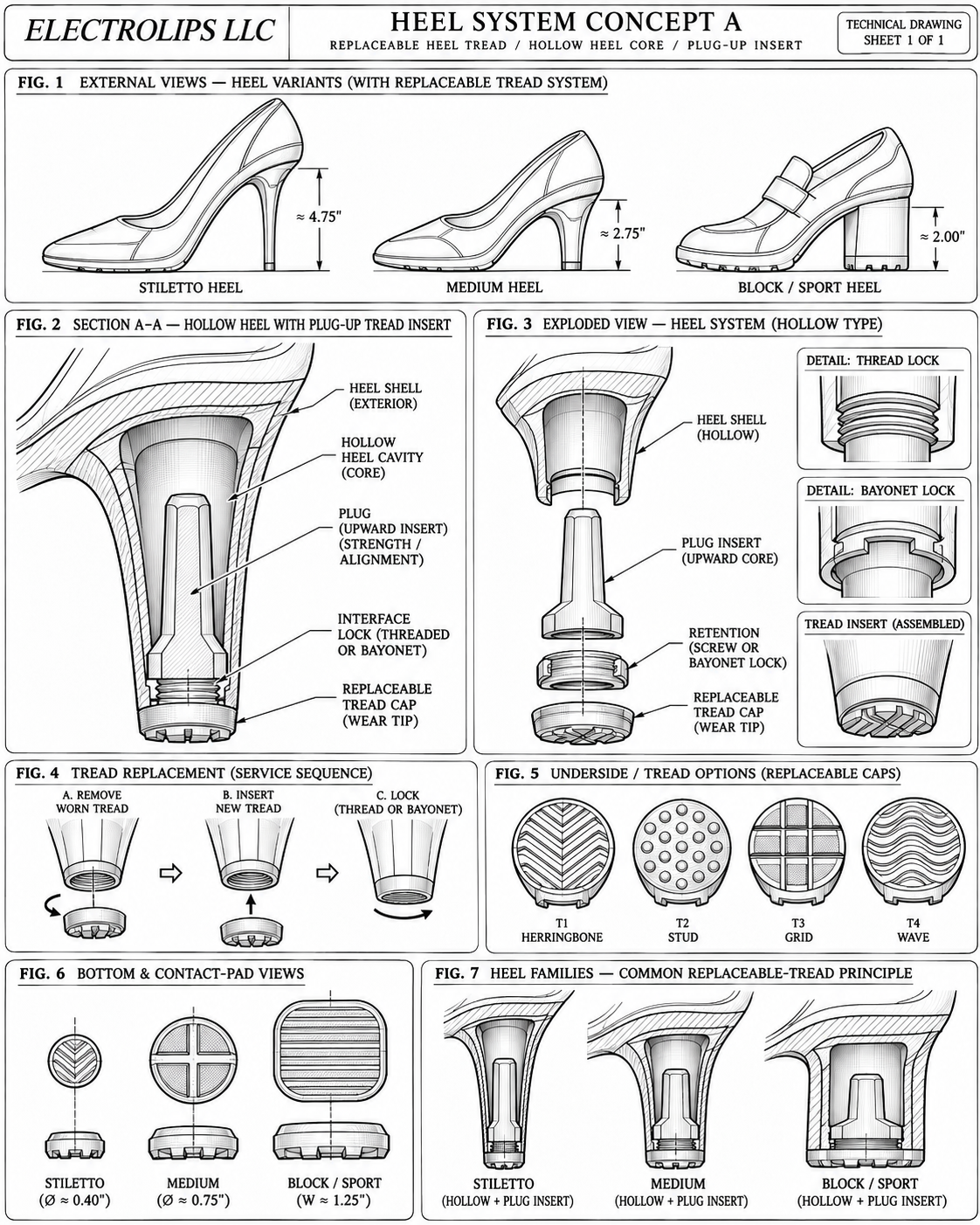
electrolips_heel_system_technical_board.pngOpen full-size drawing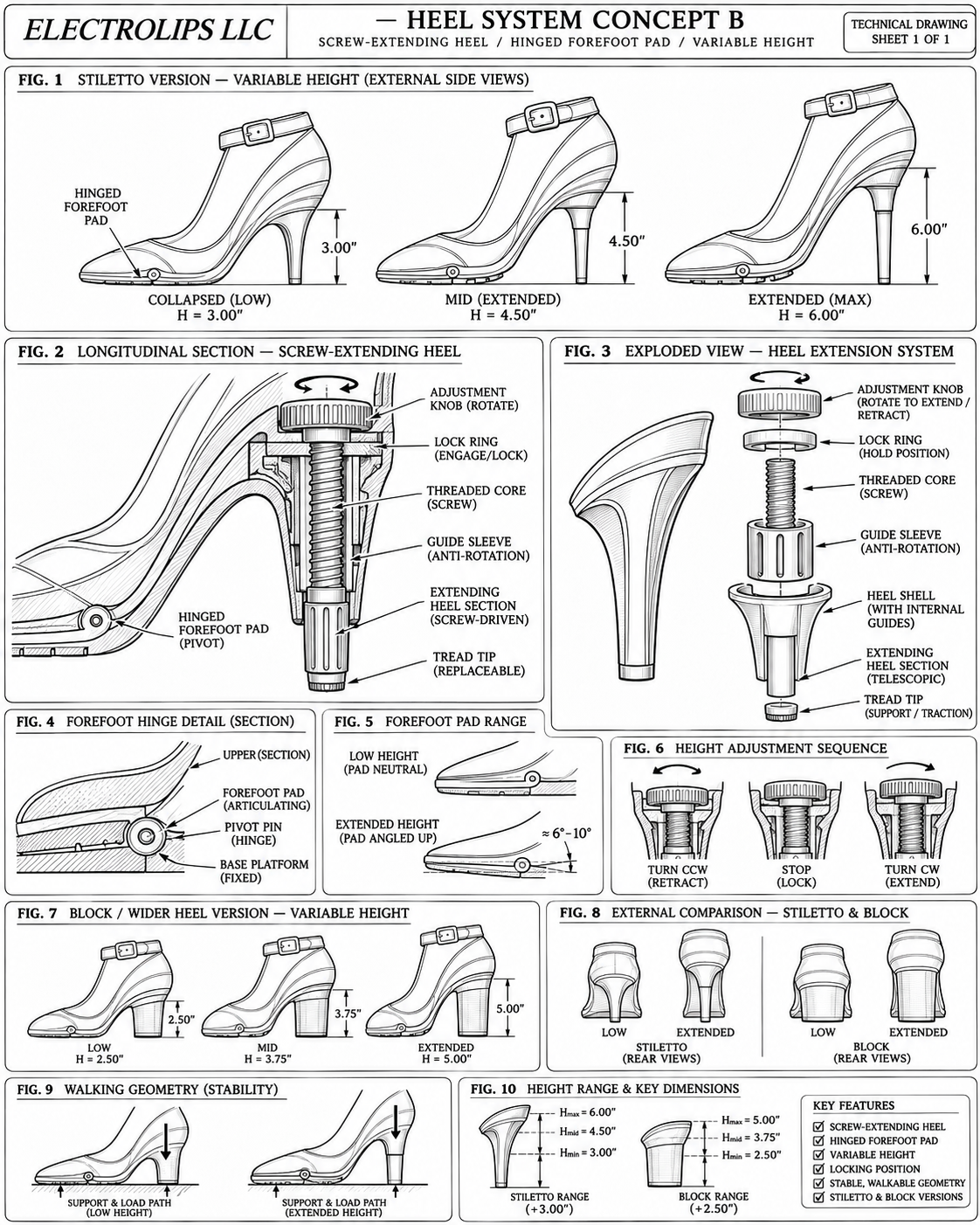
retractable_heel_system_engineering_board.pngOpen full-size drawing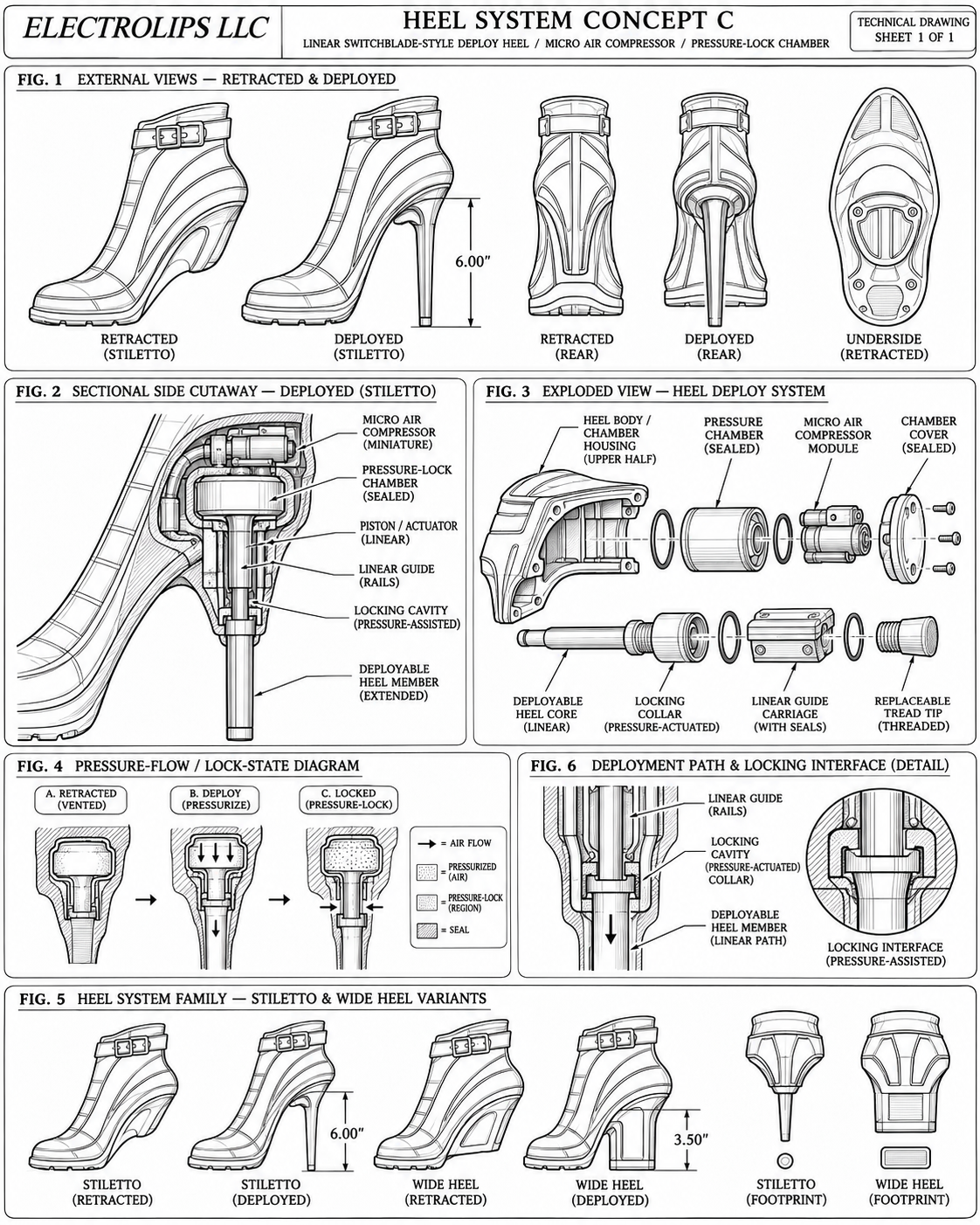
electrolips_deployable_heel_patent_board.pngOpen full-size drawing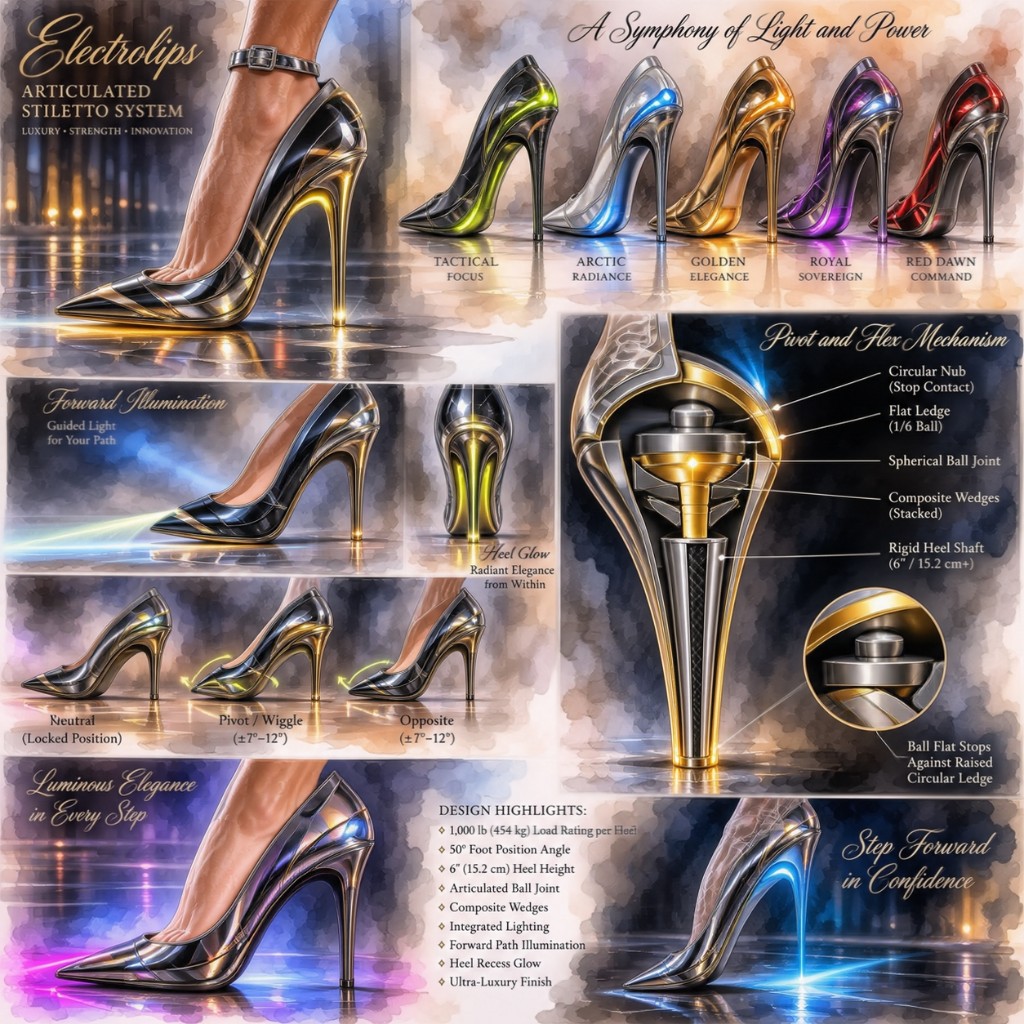
3122.pngOpen full-size drawing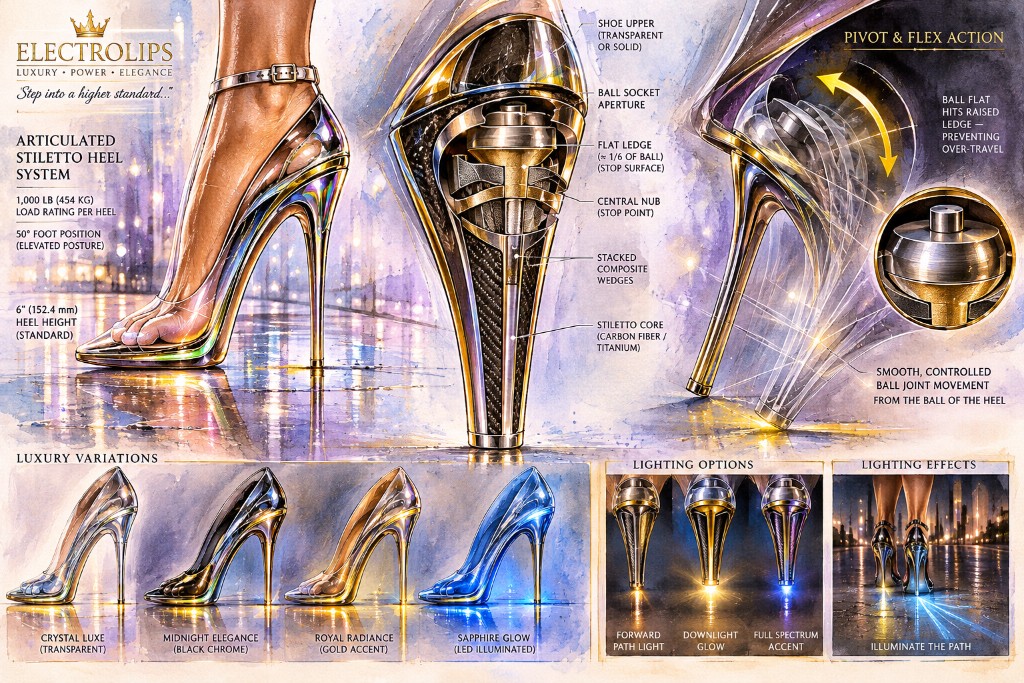
3123.pngOpen full-size drawing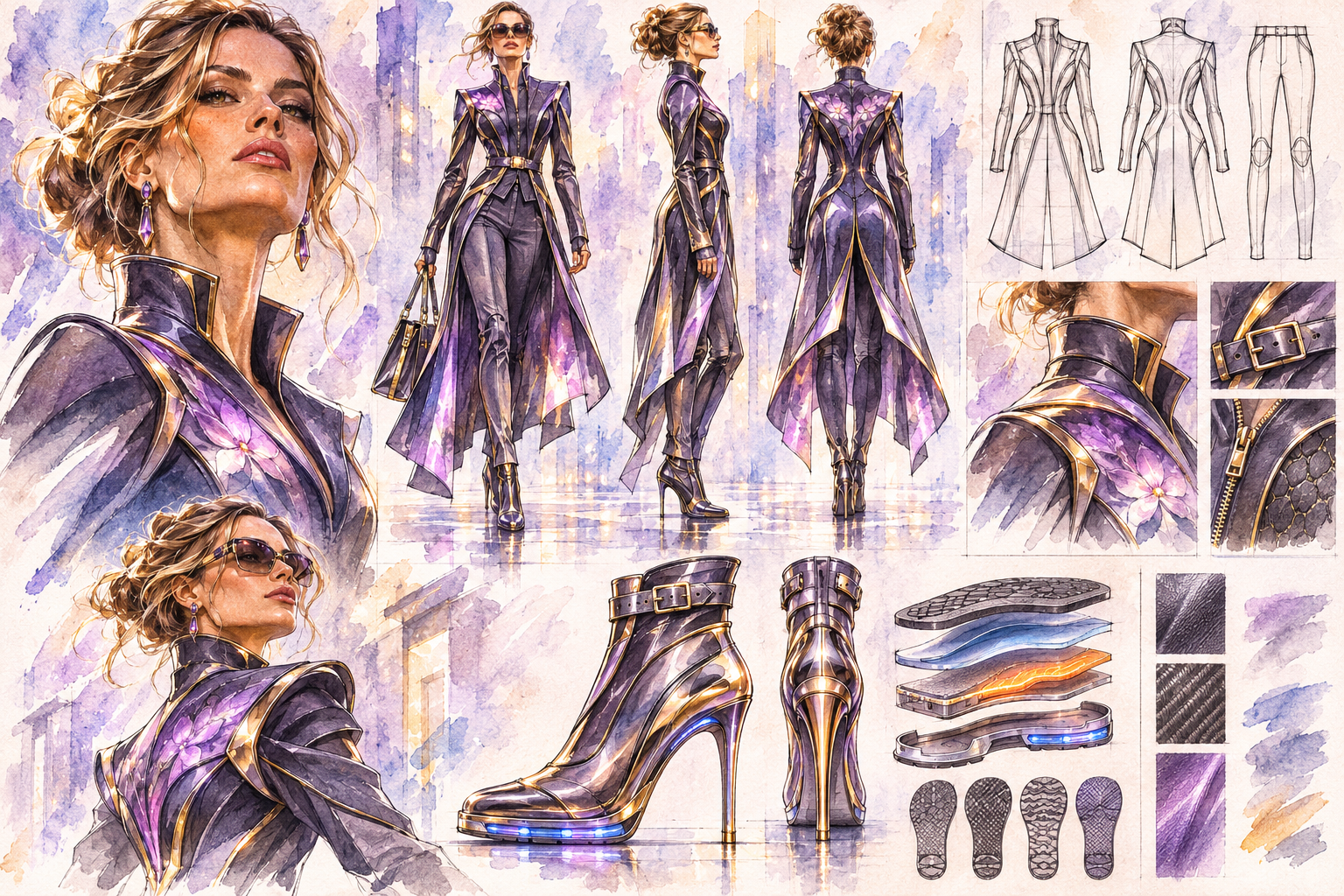
Watercolor Futuristic Fashion Concept Board.pngOpen full-size drawing
3124.pngOpen full-size drawing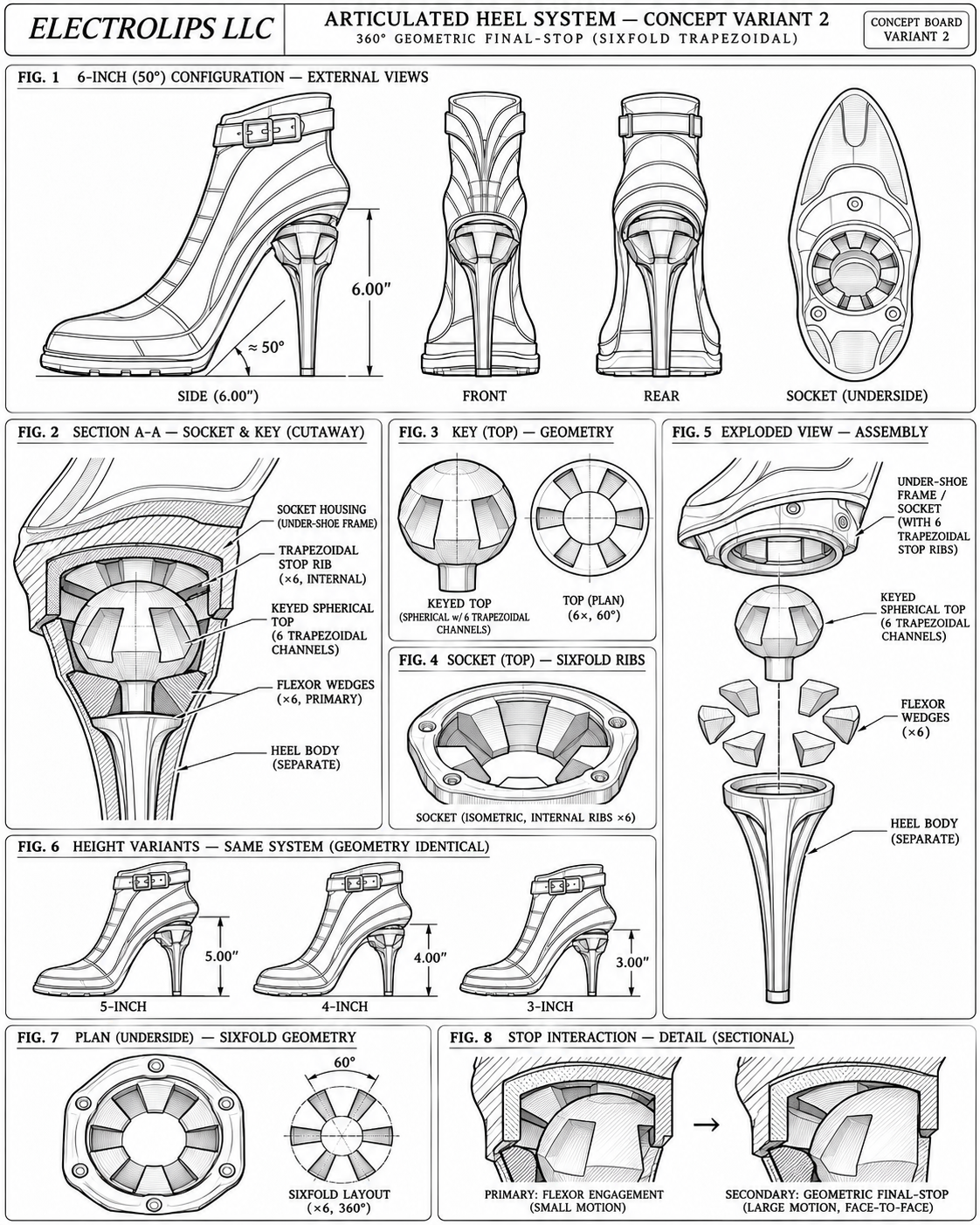
ChatGPT Image Nov 11, 2026, 04_19_23 AM-2.pngOpen full-size drawing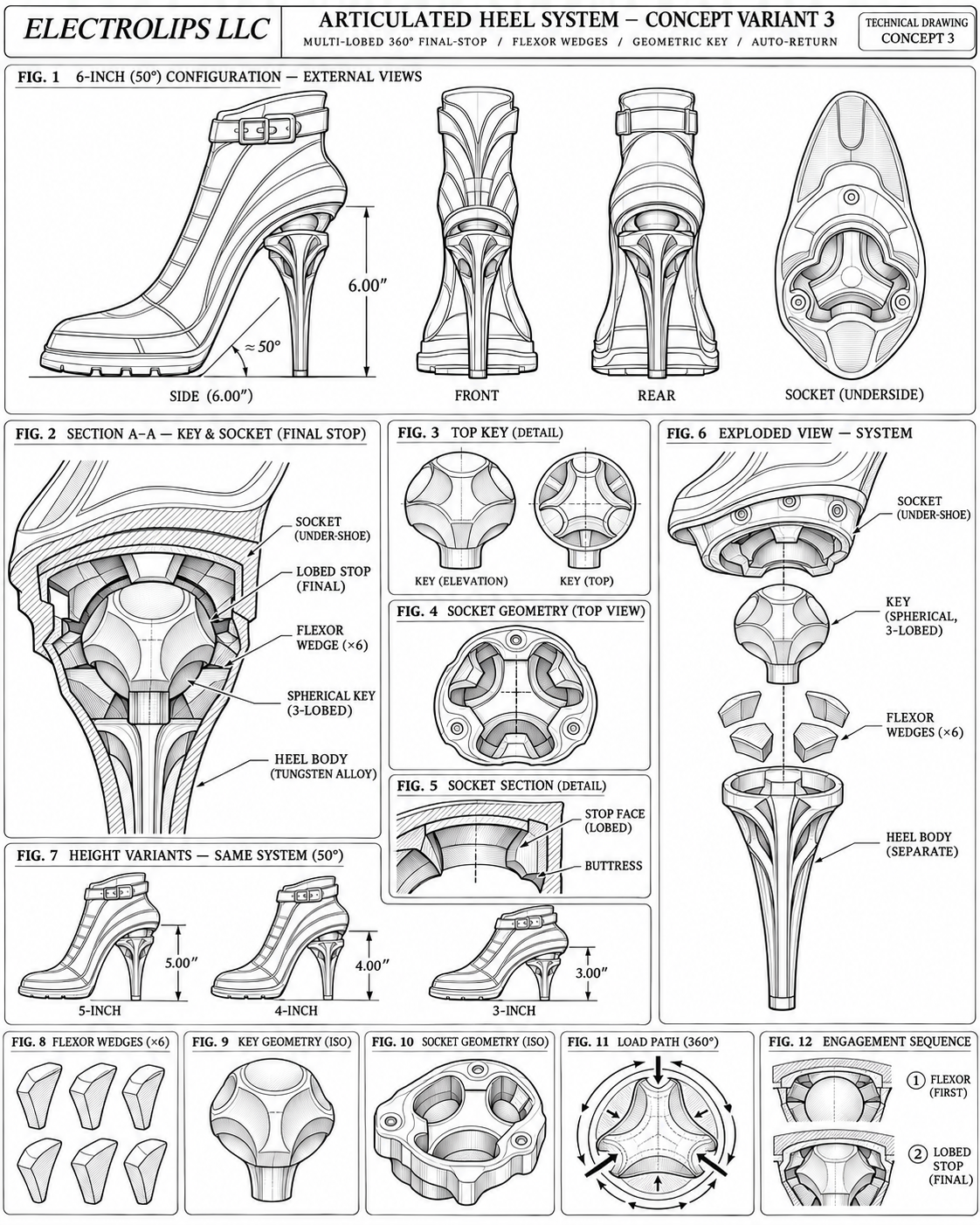
ChatGPT Image Nov 11, 2026, 04_19_24 AM-3.pngOpen full-size drawing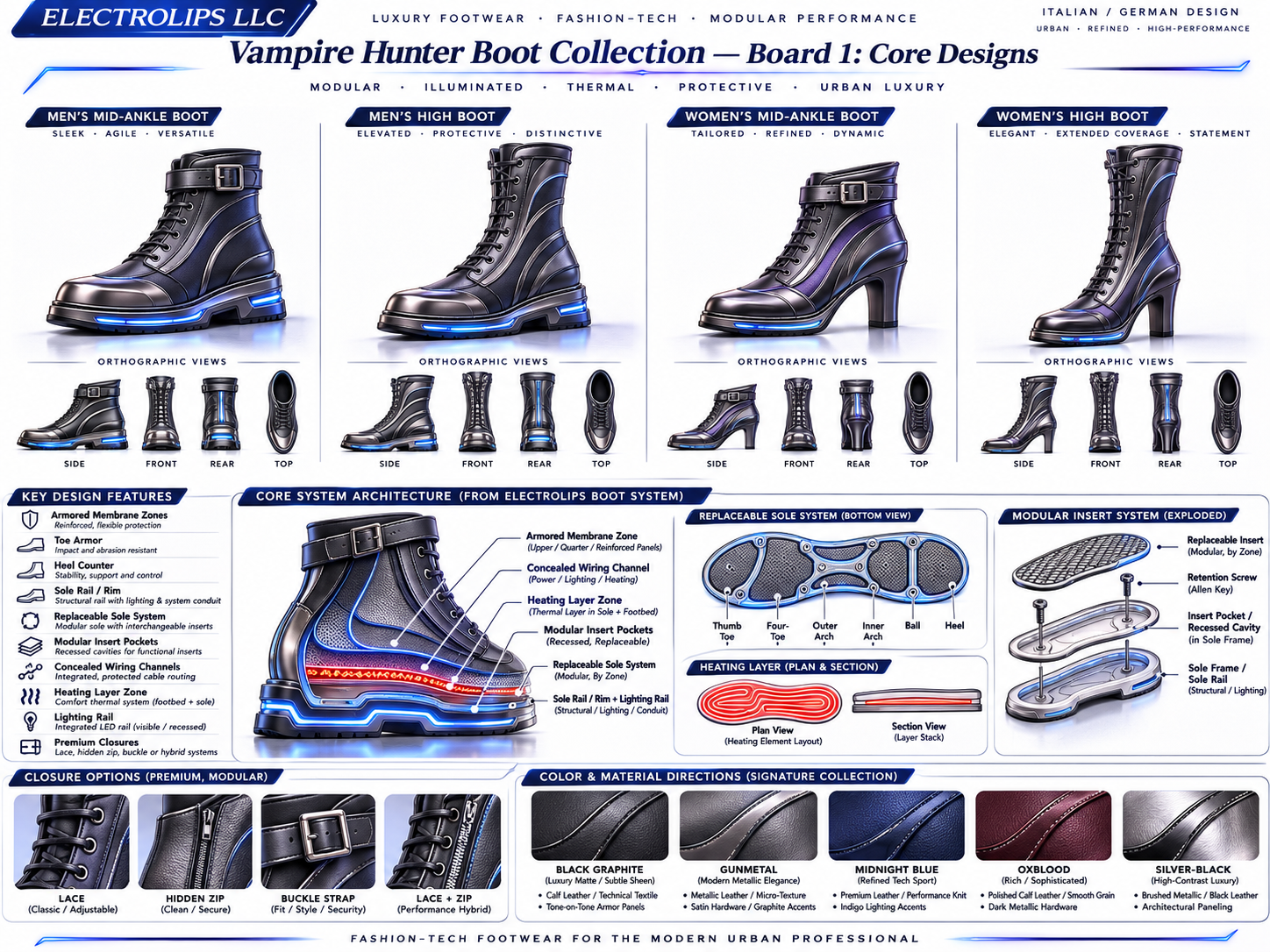
image-gen-1(2).pngOpen full-size drawing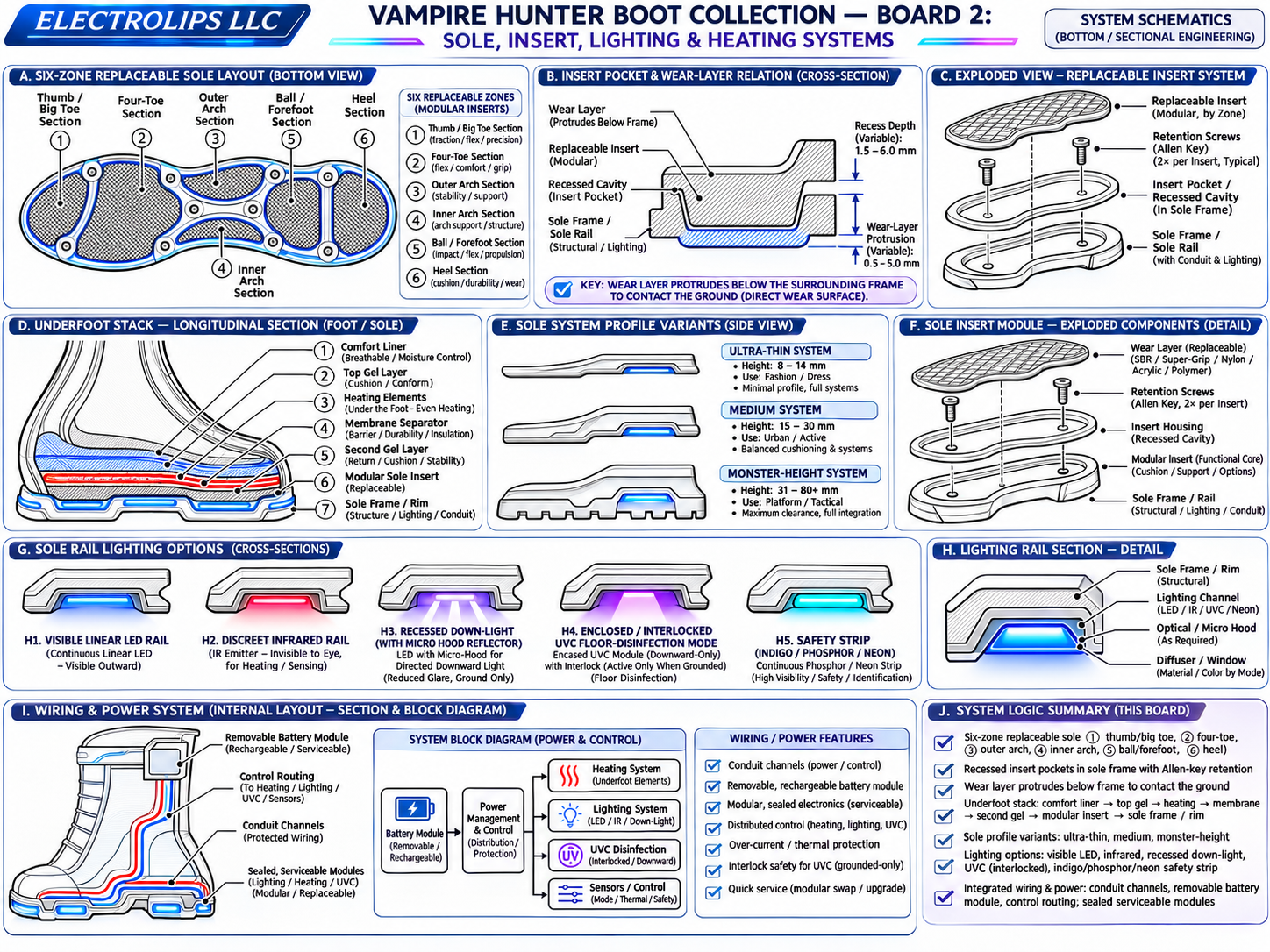
image-gen-2(2).pngOpen full-size drawing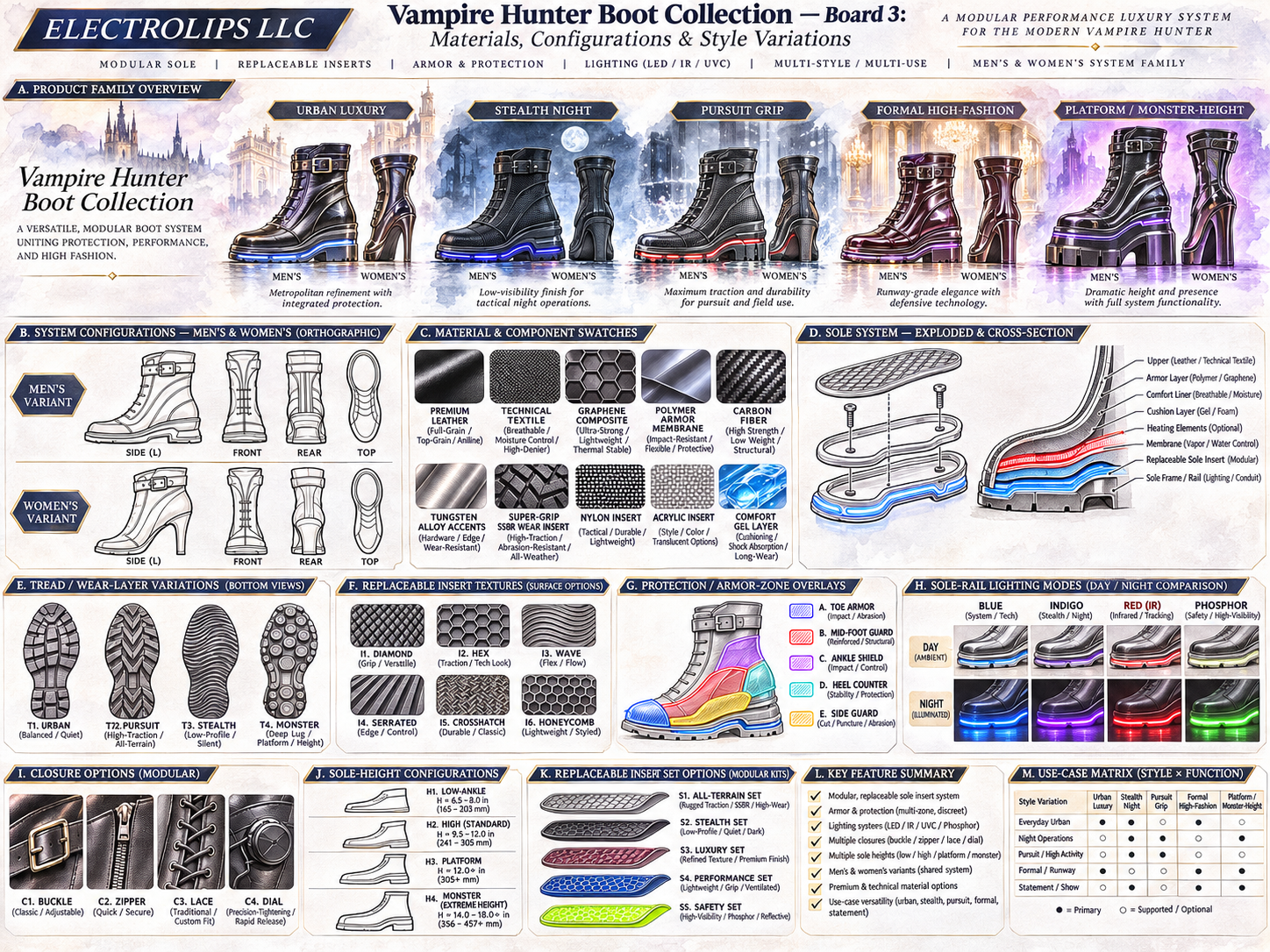
image-gen-3(2).pngOpen full-size drawing
3133.pngOpen full-size drawing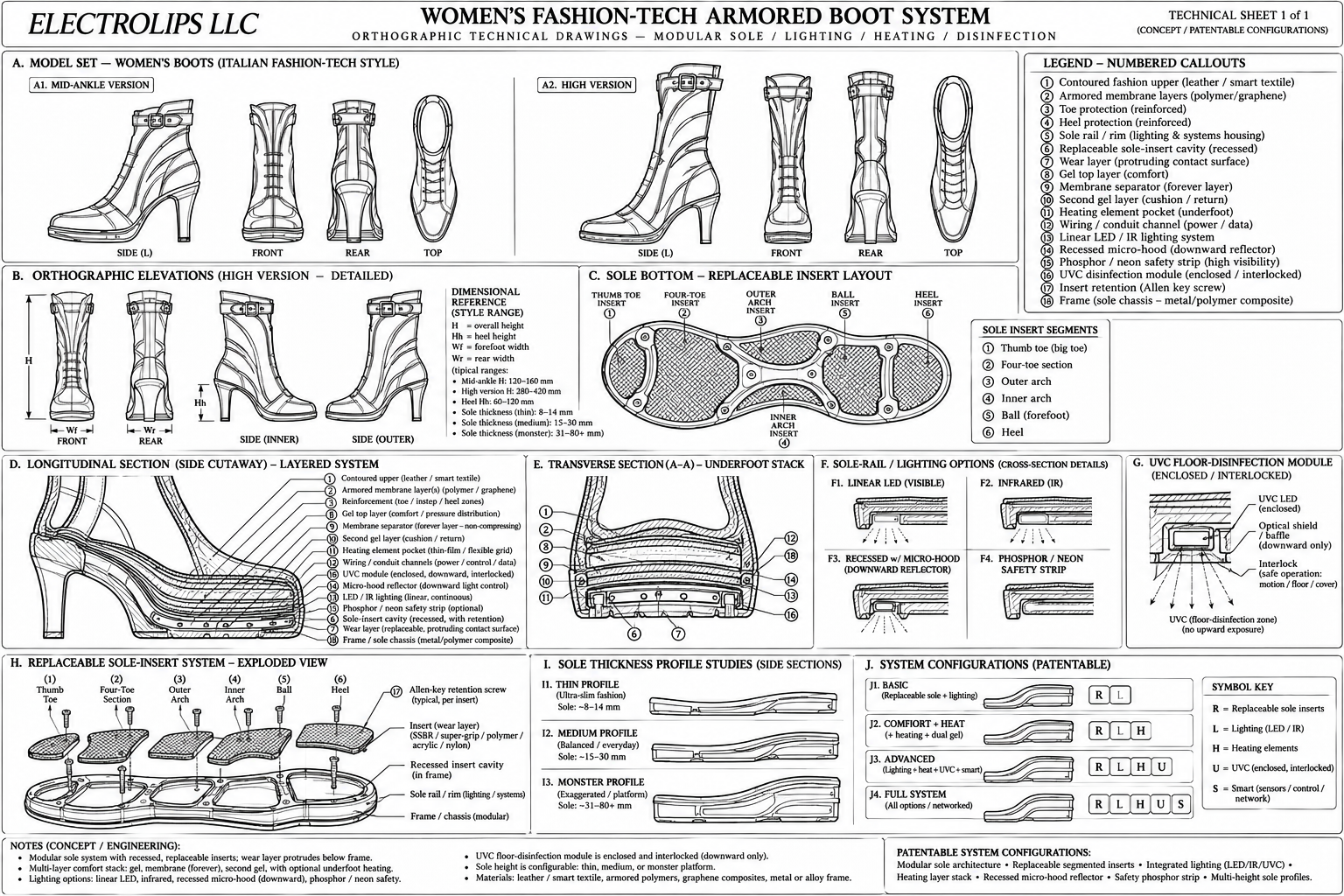
Fashion-Tech Armored Boot Blueprint.pngOpen full-size drawing.png)
Fashion-Tech Armored Boot Blueprint(1).pngOpen full-size drawing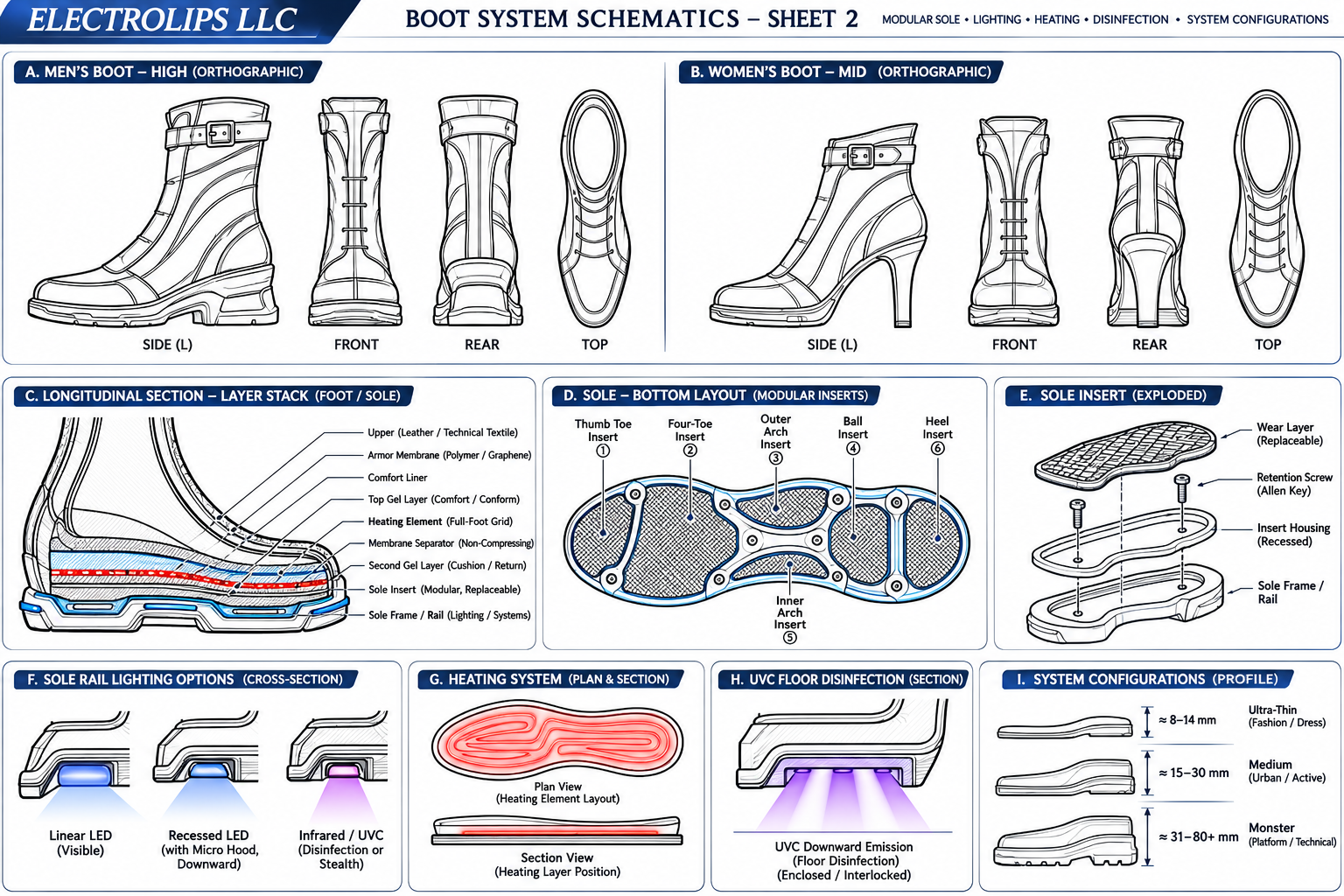
Electrolips Boot System Schematics.pngOpen full-size drawing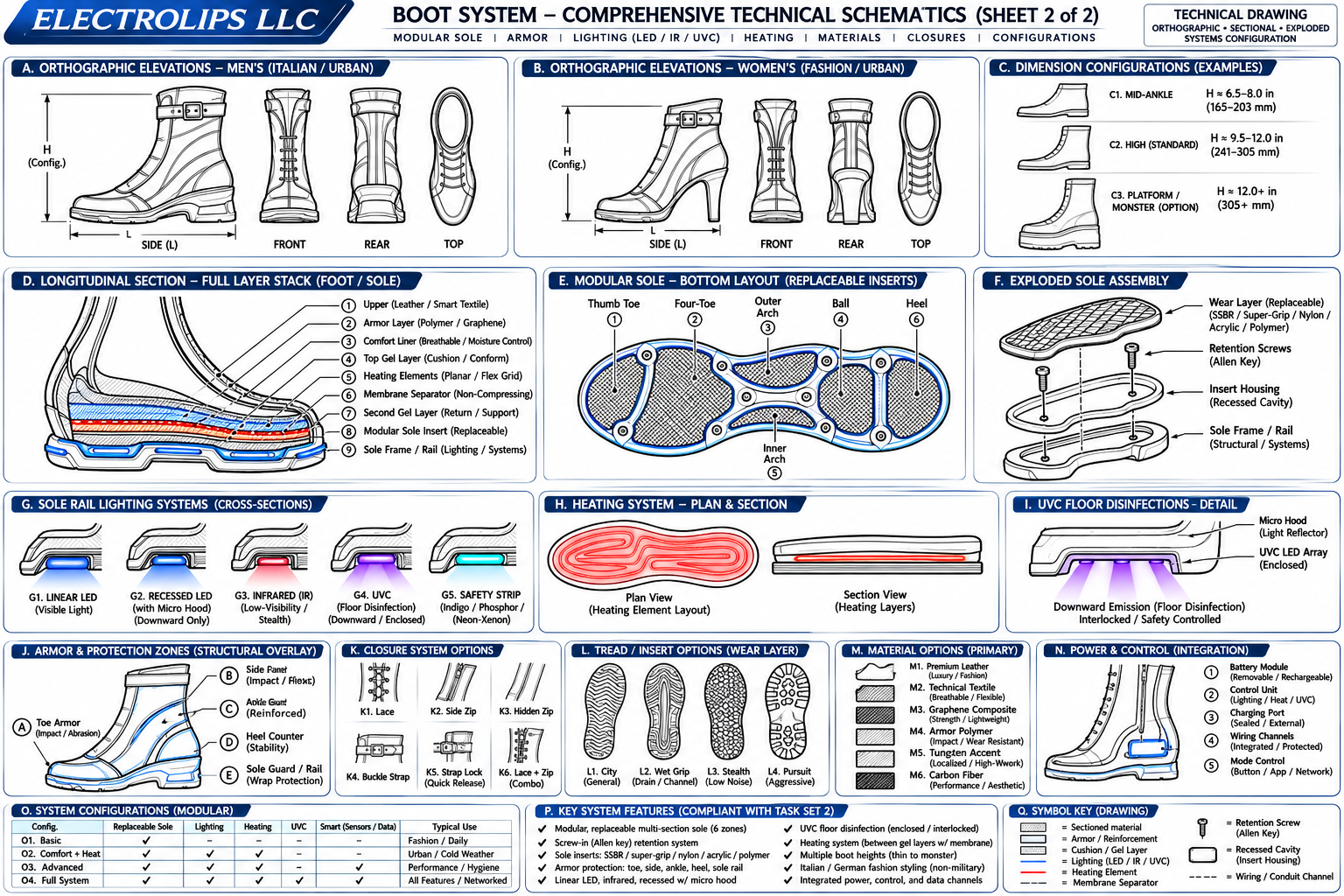
Electrolips Modular Boot Systems Blueprint.pngOpen full-size drawing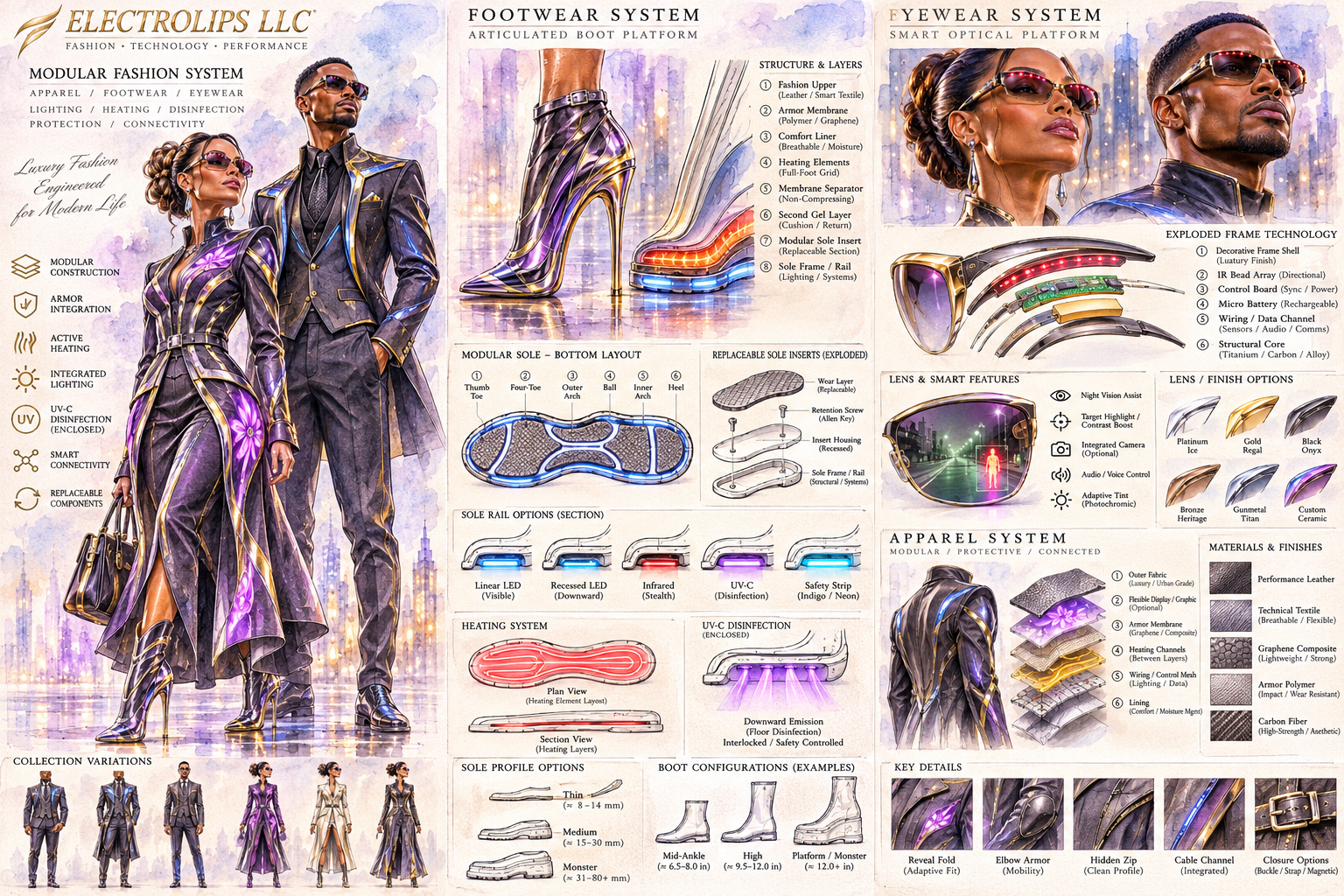
Electrolips Modular Fashion Triptych.pngOpen full-size drawing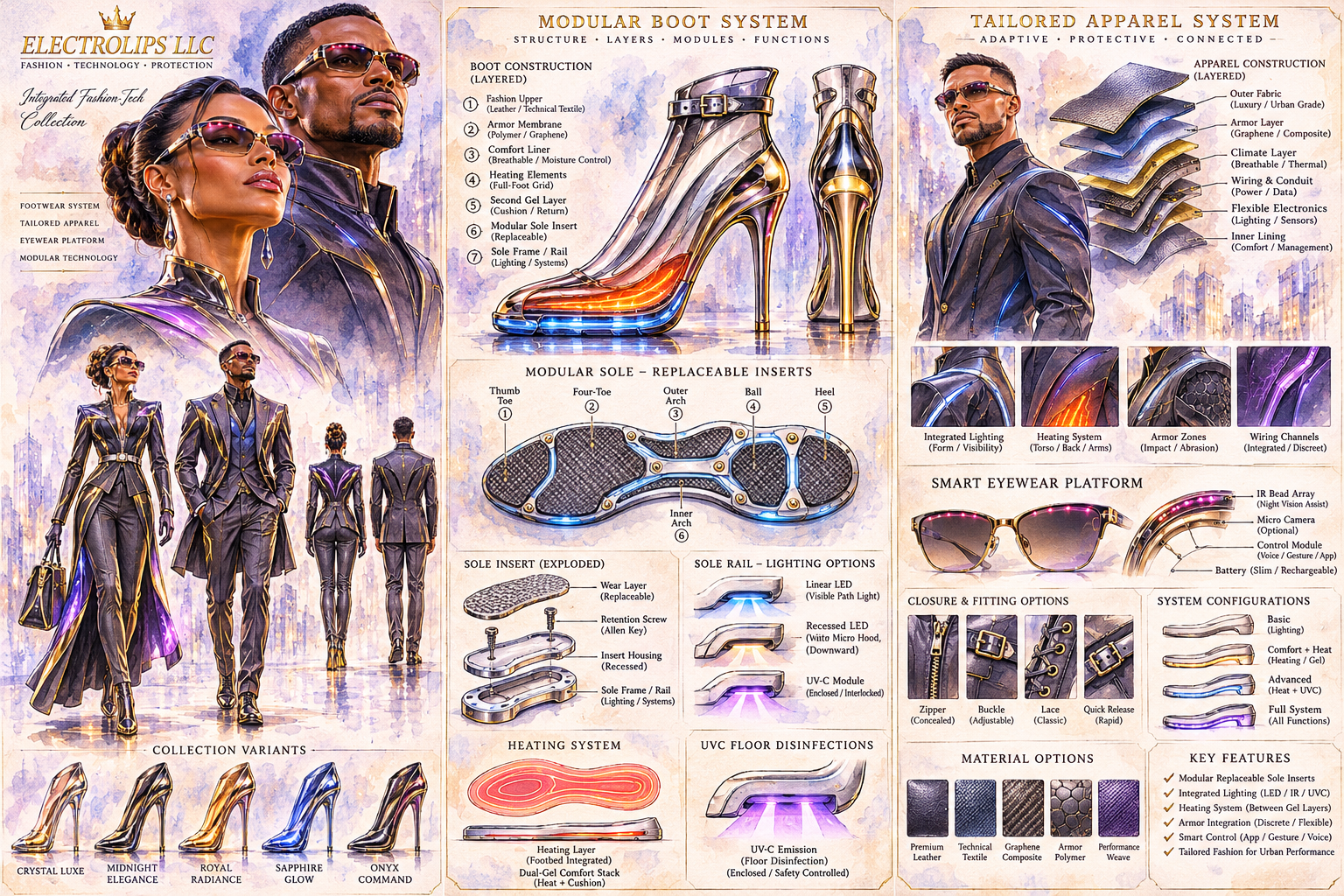
Electrolips Integrated Fashion-Tech Collection.pngOpen full-size drawing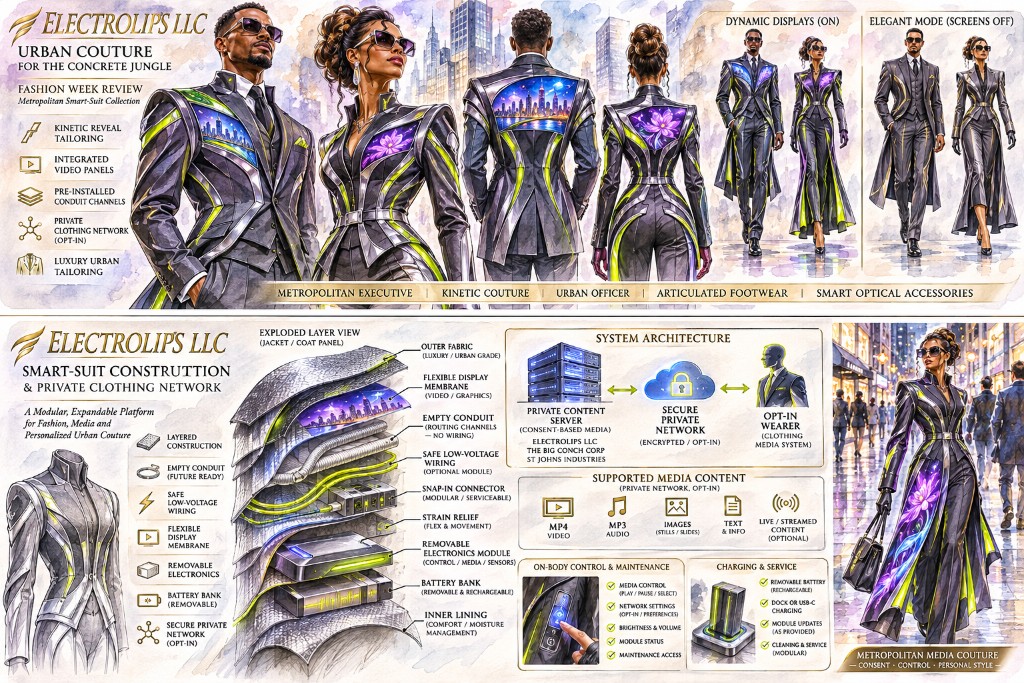
3129.pngOpen full-size drawing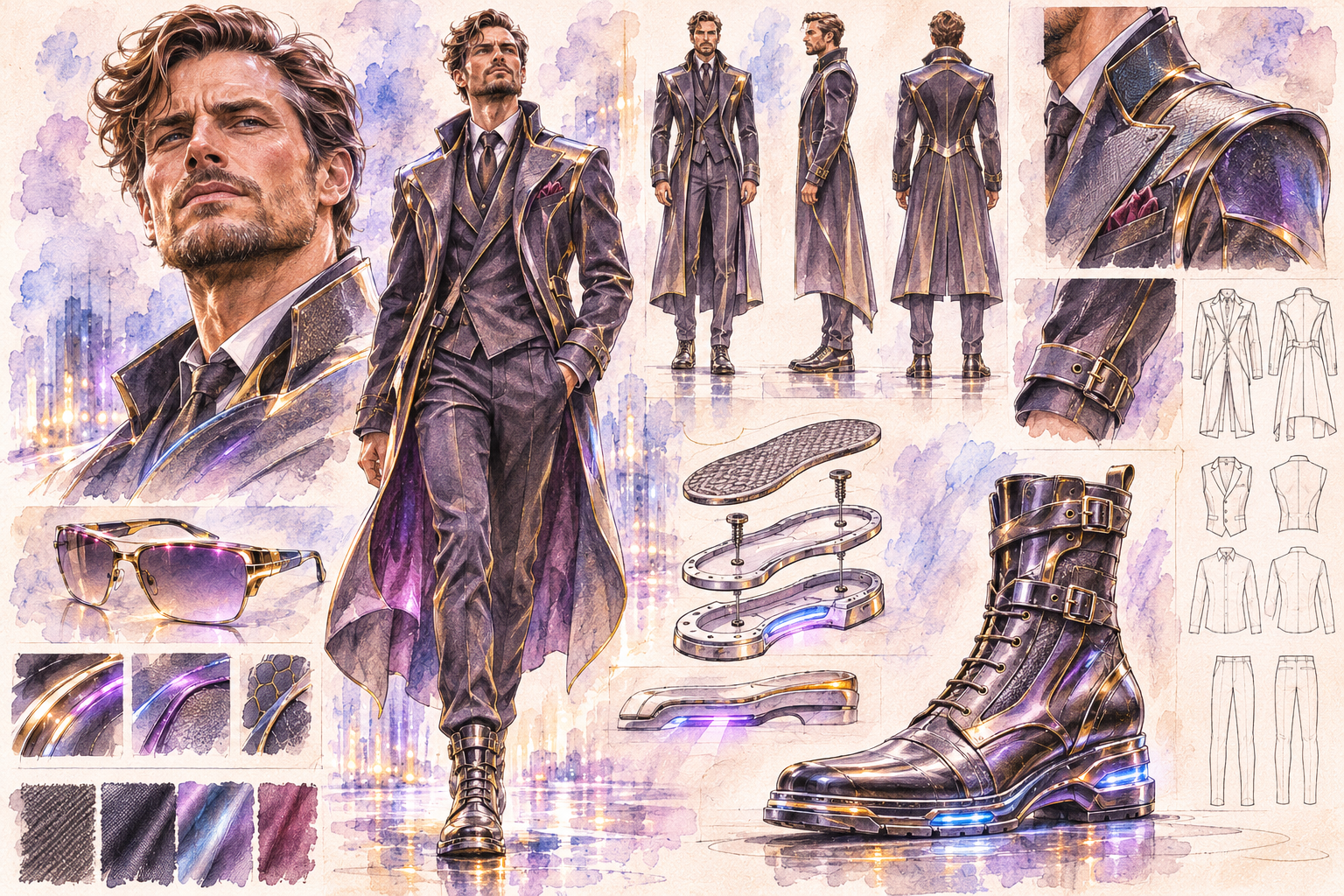
Luxury Techwear Character Concept Board.pngOpen full-size drawing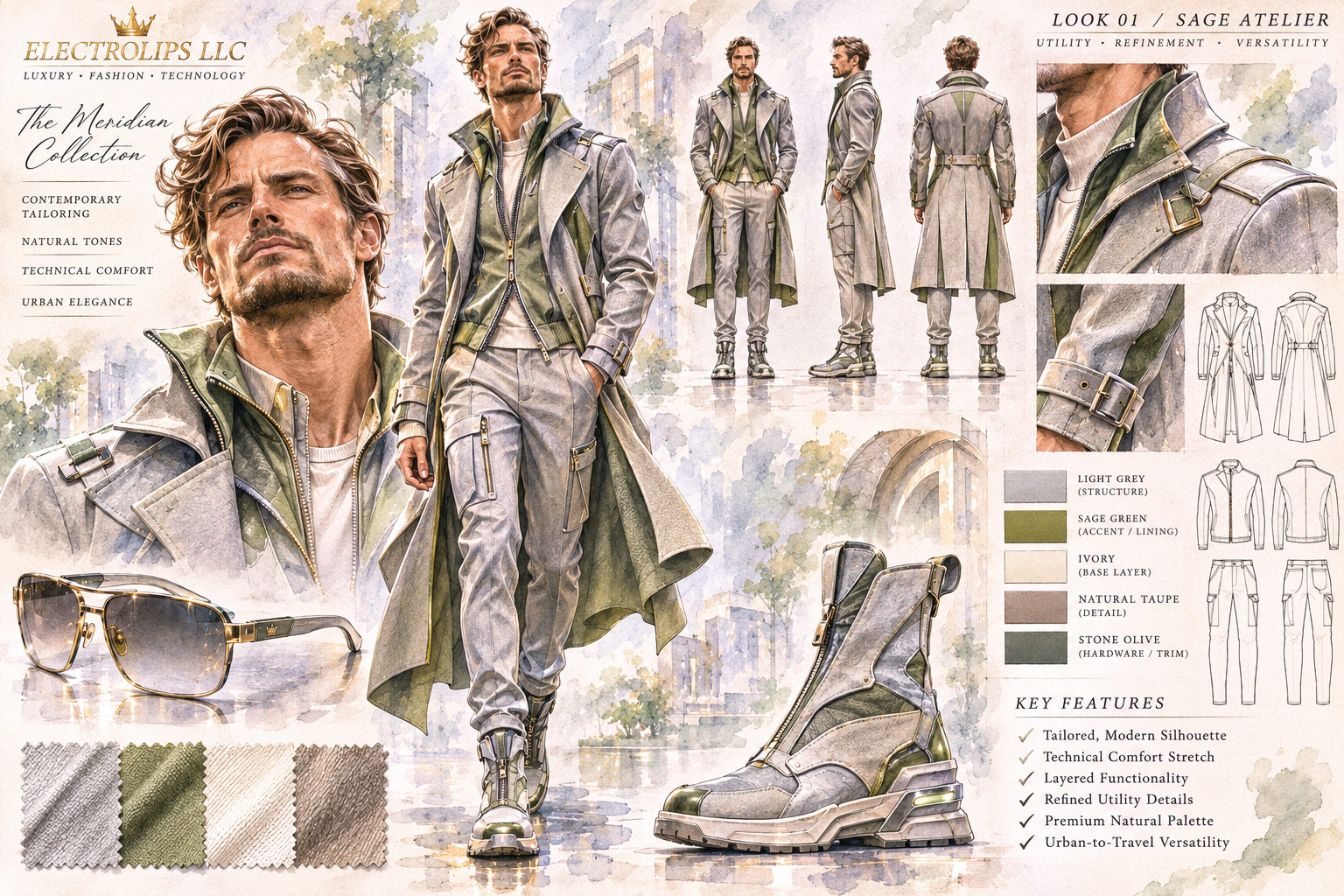
The Meridian Collection: Sage Atelier.pngOpen full-size drawing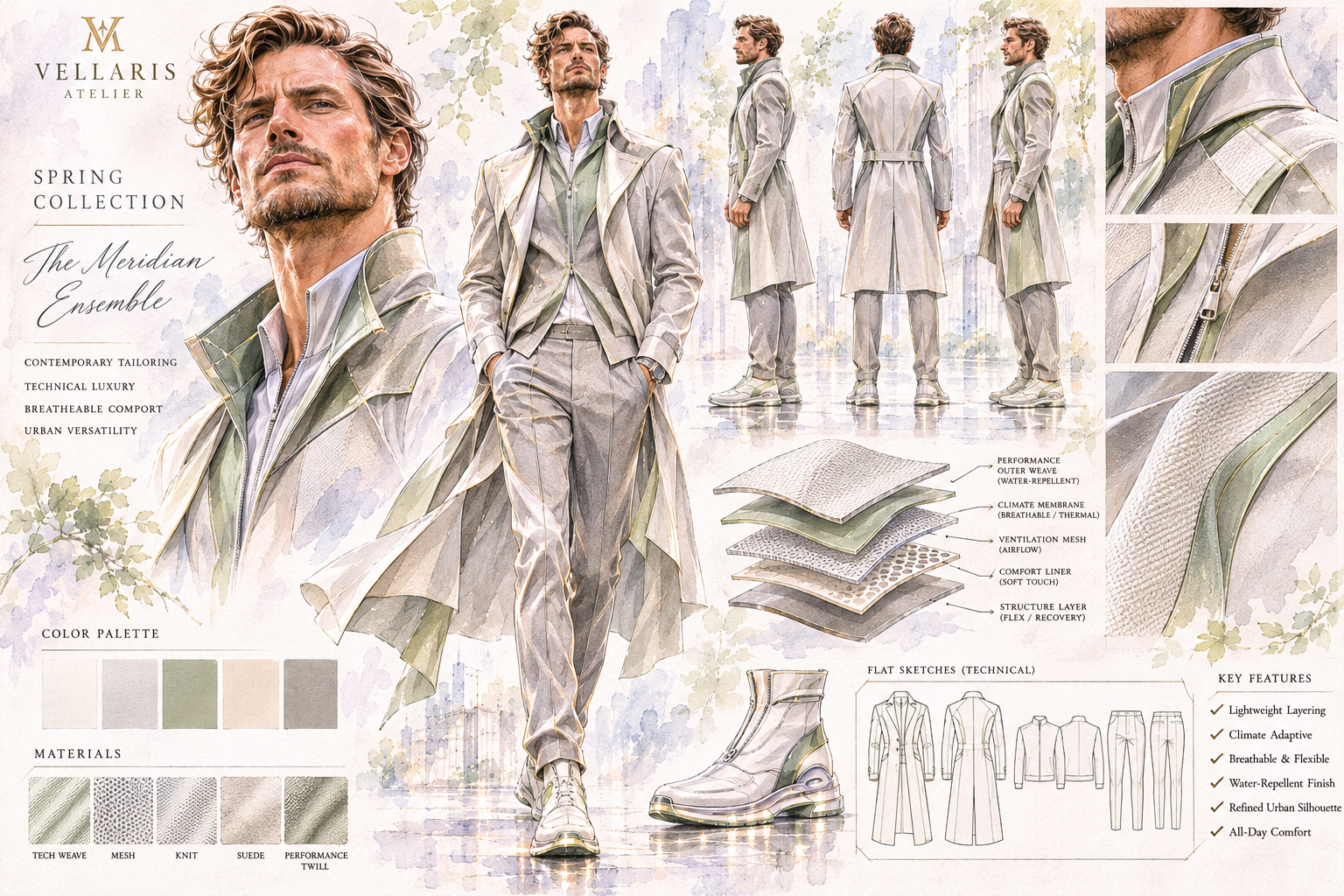
Vellaris Meridian Ensemble Board.pngOpen full-size drawing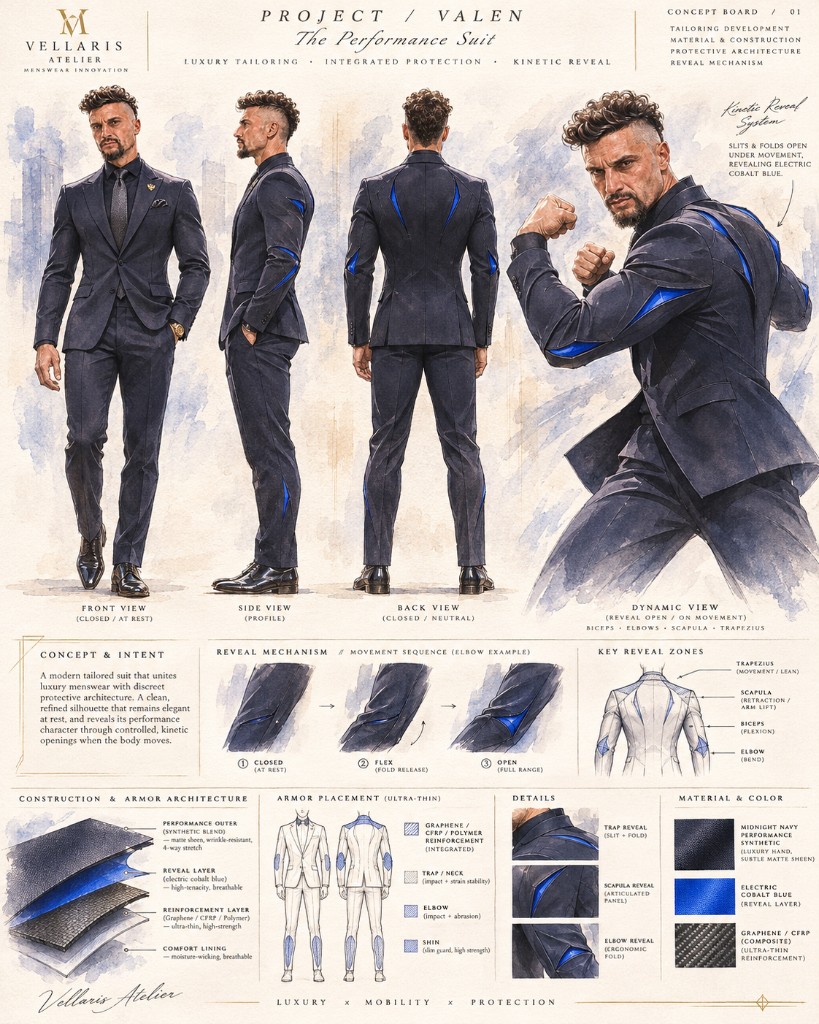
3116.pngOpen full-size drawing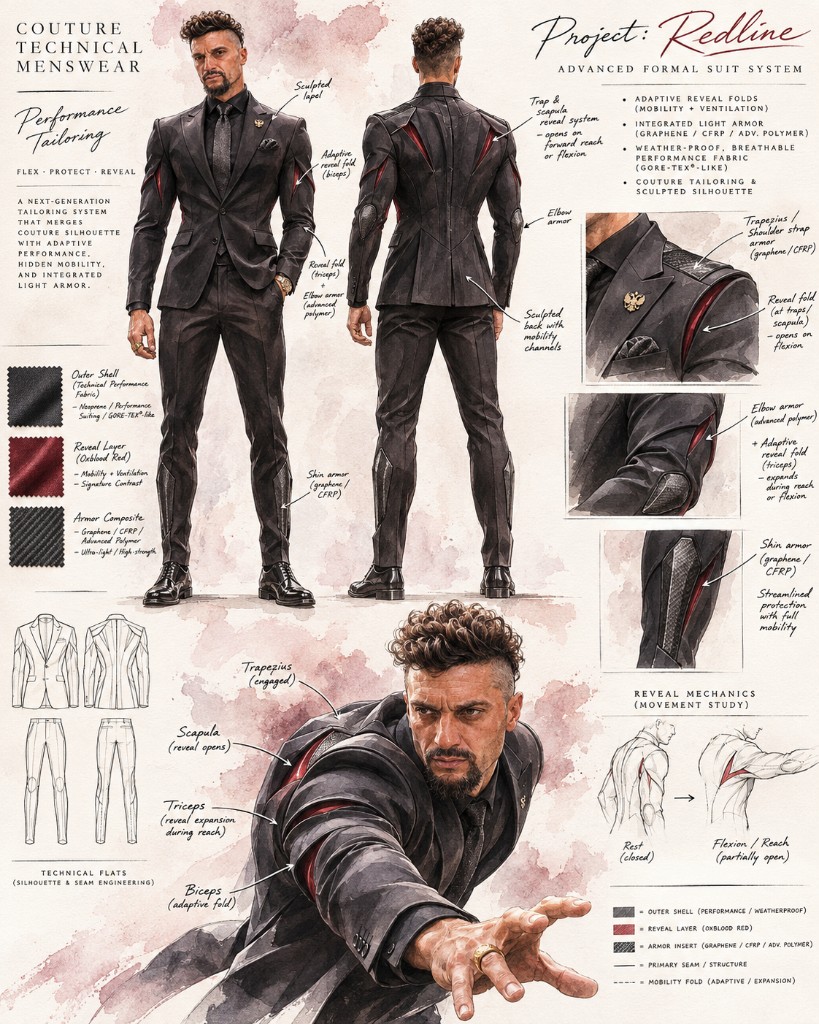
3117.pngOpen full-size drawing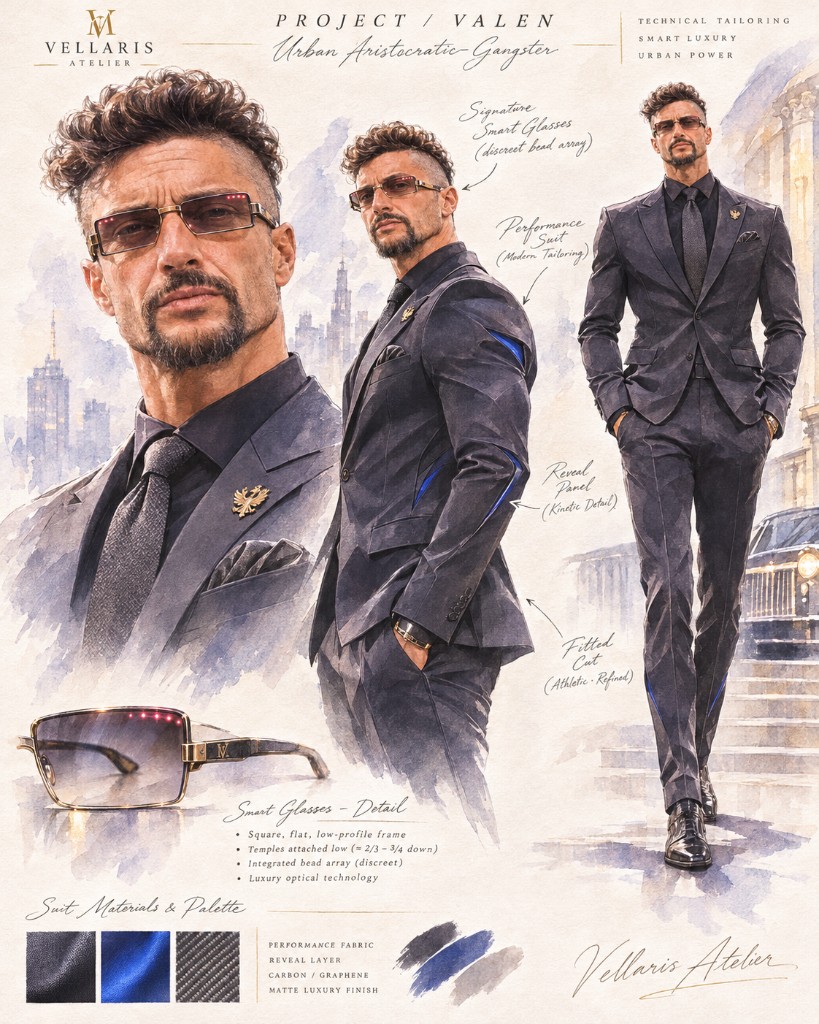
3125(1).pngOpen full-size drawingPreviously uploaded duplicates / alternate names
ChatGPT Image Nov 11, 2026, 04_30_24 AM.png → 3123.png (identical file)
ChatGPT Image Nov 11, 2026, 04_30_38 AM.png → 3122.png (identical file)
ChatGPT Image Nov 11, 2026, 04_31_26 AM.png → 3122.png (identical file)
ChatGPT Image Nov 11, 2026, 04_30_46 AM.png → image-gen-3(2).png (same design)
ChatGPT Image Nov 11, 2026, 04_30_55 AM.png → image-gen-1(2).png (same design)
ChatGPT Image Nov 11, 2026, 04_31_09 AM.png → Fashion-Tech Armored Boot Blueprint.png (same design)
ChatGPT Image Nov 11, 2026, 04_31_19 AM.png → image-gen-2(2).png (same design)
imagegen.png → electrolips_heel_system_technical_board.png (identical file)
EDITORIAL AND TEST REFERENCE DESK
The illustrations are concept and design boards. No independently verified load, fatigue-life, slip-prevention or injury-prevention results have been supplied. The 1,000-pound load and 80,000-hour service-life objectives must be treated as development targets until demonstrated by qualified testing. The pneumatic and variable-height heel drawings describe research mechanisms, not finished consumer products.
ASTM F2913-24 — whole-shoe slip performance · ISO 20871:2018 — outsole abrasion · ISO 17707:2005 — outsole flex.
The editorial is an original review of the diagrams and invention descriptions presented in this conversation, prepared for the Electrolips footwear section. It does not assert issued patents, certified protection, proven medical benefit or an established manufacturer.
RETURN TO FRONT PAGE